

The ability to provide onboard Wi-Fi from gate to gate has long been a key selling point for airlines. However, as non-geostationary satellites are increasingly pressed into service to power low-latency inflight connectivity, compromises and tradeoffs must be made when landing rights for NGSO services have not been secured in certain countries, such as China.
Existing multi-orbit IFC solutions that combine Low Earth Orbit (LEO) or indeed Medium Earth Orbit (MEO) satcom with a geostationary (GEO) service from a state-licensed operator, and future LEO-LEO pairings that use the same approach, handily address the conundrum.
But for operators that take the LEO-only IFC route for their fleets in the here and now, it will be important to manage passenger expectations.
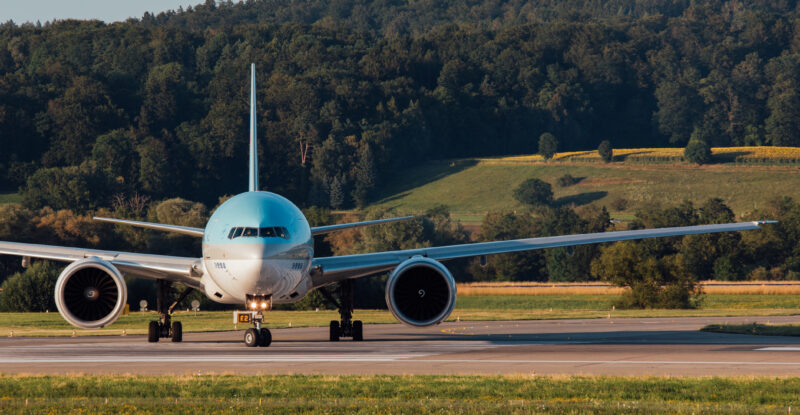
And so, we turn to Korean Air and Asiana Airlines, which are progressively rolling out SpaceX’s Starlink LEO satellite-powered IFC to provide complimentary Wi-Fi to passengers, but are alerting them to expect gaps over China, India and Pakistan.
“Service will be temporarily unavailable when the aircraft passes through the airspace of certain countries where satellite communication approvals are restricted (e.g., China, India, Pakistan, etc.). Connectivity will automatically resume once the aircraft exits these airspace,” says Asiana in the FAQ section of its Starlink-focused web page.
Laying claim to being the “first full service carrier in East Asia to introduce Starlink connectivity,” Korean states on its web site: “The service is restricted in the airspace over certain countries (e.g., China, India, and Pakistan).” It also notes that “temporary disconnections may occur depending on weather conditions or the flight path.”
Given that both carriers have a strong presence in China and indeed on routes that overfly China — and the fact that they’re in line to complete their merger on December 17 — the decision to adopt Starlink fleet-wide is seen as a bit of a head-scratcher to some industry engineers.
After all, when analyzing the trade-offs of satcom mission architecture, the “three C’s” of coverage, capacity and cost have traditionally been considered. Do market differentiation and other factors now take priority over coverage?
Any aero customers of LEO-specific inflight connectivity service that isn’t state approved should remain vigilant about disabling service when flying in or over China, industry insiders tell Runway Girl Network, pointing to reports that China late last year penalized an international vessel after authorities found it was using Starlink while operating inside Chinese territorial waters.

As of September 15, Asiana says Starlink is available “on select routes” operated by A350 and A330 aircraft. Korean says Starlink is flying on three freshly retrofitted A350-900s and one Boeing 777-300ER operating “medium-and long-haul routes across the Americas, Europe, and Southeast Asia, as well as on key short-haul flights.”
While not addressing RGN’s specific question about the China coverage gap, a spokesperson for Korean Air says the Starlink installation work is being carried out at Korean Air and Asiana’s in-house hangars. “It is primarily performed by our skilled in-house MRO teams, supplemented by specialized external partners.”
Korean Air has its own MRO company, Korean Air Aerospace, which has commercial MRO facilities at Seoul Gimpo, Seoul Incheon and Busan. The SkyTeam Alliance member expects to progressively bring Starlink to its in-service fleet by the end of 2027.
Related Articles:
- United pipes live football via DISH to Starlink-enabled seatback IFE
- Now critical, IFC needs resiliency, security: Eutelsat’s Bisgaard
- Panasonic, Spacesail to launch multi-network LEO IFC in 2027
- Hughes stays flexible with ESA, double-ESA and hybrid ESA-VICTS IFC
- Airbus open to IFC orchestration should multi-vendor take off
- China Southern picks SES as MSP for 30 A350s contracted for HBCplus
Featured image credited to istock/Fabian Gysel