

 Eurostar is the dominant international rail company operating between London, Paris, Brussels and Amsterdam. But while the high-speed service provides an important alternative to flying, its dominance has increasingly been accompanied by higher fares and perceived declines in passenger experience.
Across most of Eurostar’s core network, there is little meaningful competition from high-speed rail operators. The Brussels-Amsterdam route is a notable exception, however, as EuroCity and EuroCity Direct link Brussels with Rotterdam, Amsterdam and other Dutch destinations.
Slower on paper, lighter on frills, and less expensive, EuroCity Direct promises something that Eurostar sometimes struggles to deliver: a straightforward, comfortable train journey. But do its cheaper fares make the PaxEx compromises worth it?
To see whether this service is a credible alternative, I booked a first class EuroCity Direct trip from Brussels Midi to Rotterdam Centraal in the Netherlands to put it to the test.
I arrived at Brussels Midi one hour before departure. Even though I held a first-class ticket, there is no lounge access at the station. So, I waited in the concourse.
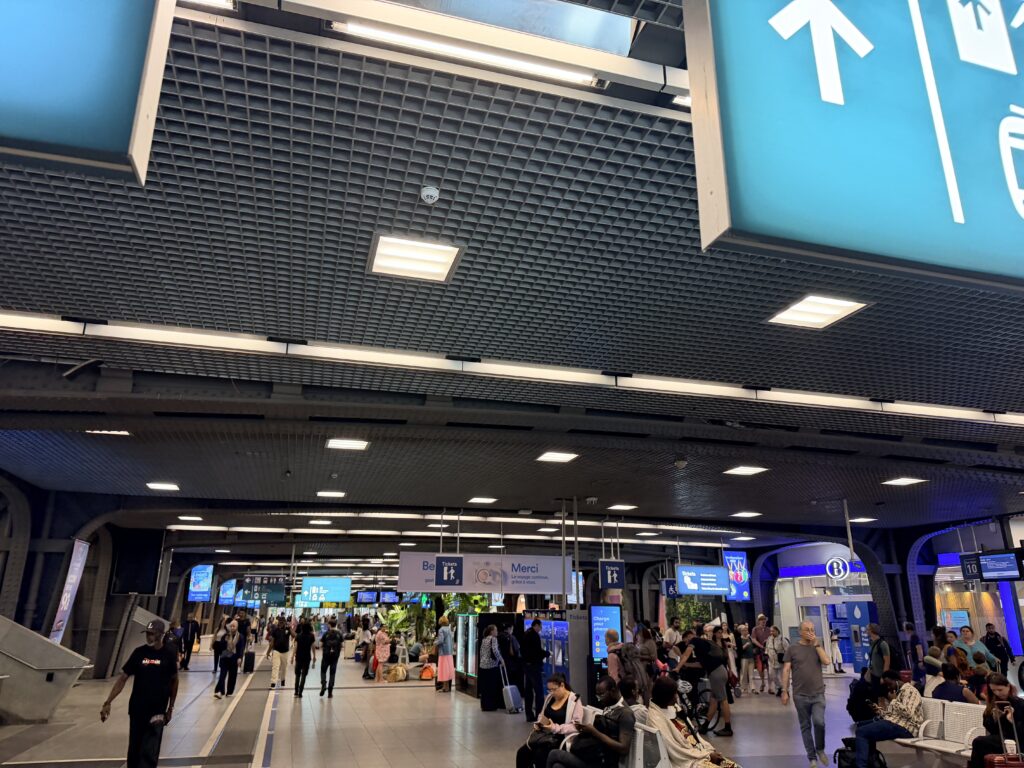
One of the less pleasant stations in Europe, Brussels Midi does at least have a number of shops and cafés to while away the time.
After sitting in the long, enclosed concourse, I headed up to the platform for some trainspotting before departure.
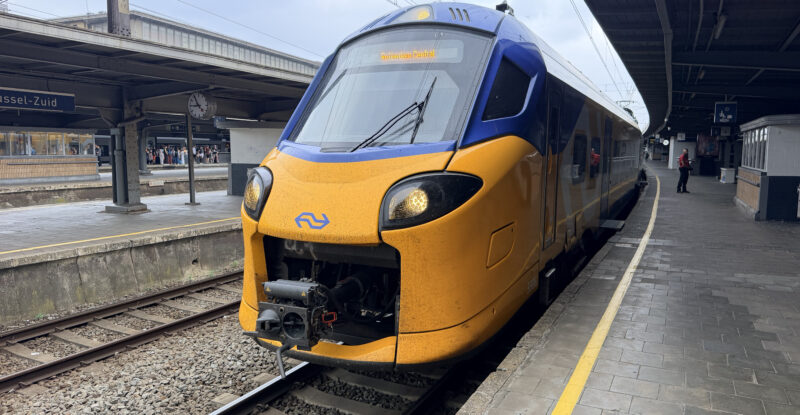
About 15 minutes before departure, the train entered the station. Operated by Dutch state railway operator Nederlandse Spoorwegen (NS), the service looked striking in the company’s iconic blue and yellow livery.
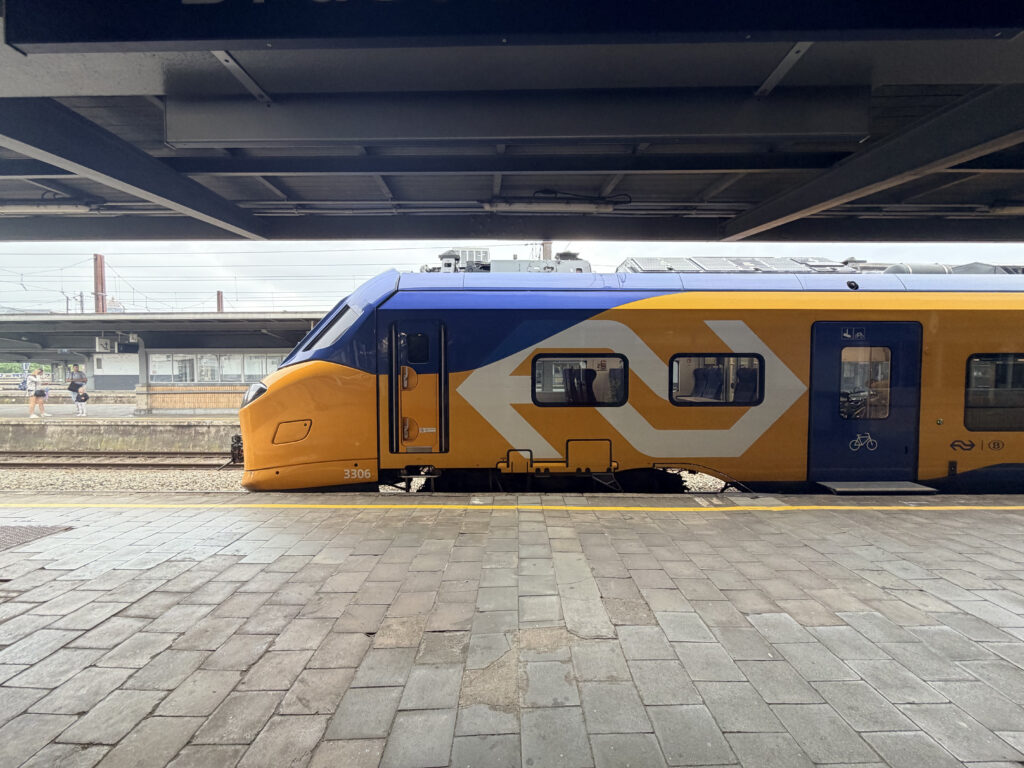
The train itself is a variation of the NS ICNG train sets, designed by Alstom and introduced in the early 2020s. These trains have 410 seats arranged across first and second class, with level boarding throughout. Slower than the Eurostar high-speed trains that also run along this route, these sets have a maximum line speed of 200 kph (125 mph).
On boarding, I was greeted by a wide, airy and spacious interior, cleverly divided into smaller zones to create a sense of intimacy. Each section is separated by glass doors, including quiet areas and more social spaces that feature couches.
Most first-class seats are arranged in a 2+1 layout, with a mix of tables and airline-style rows. With all seats unreserved, I moved around the cabin.
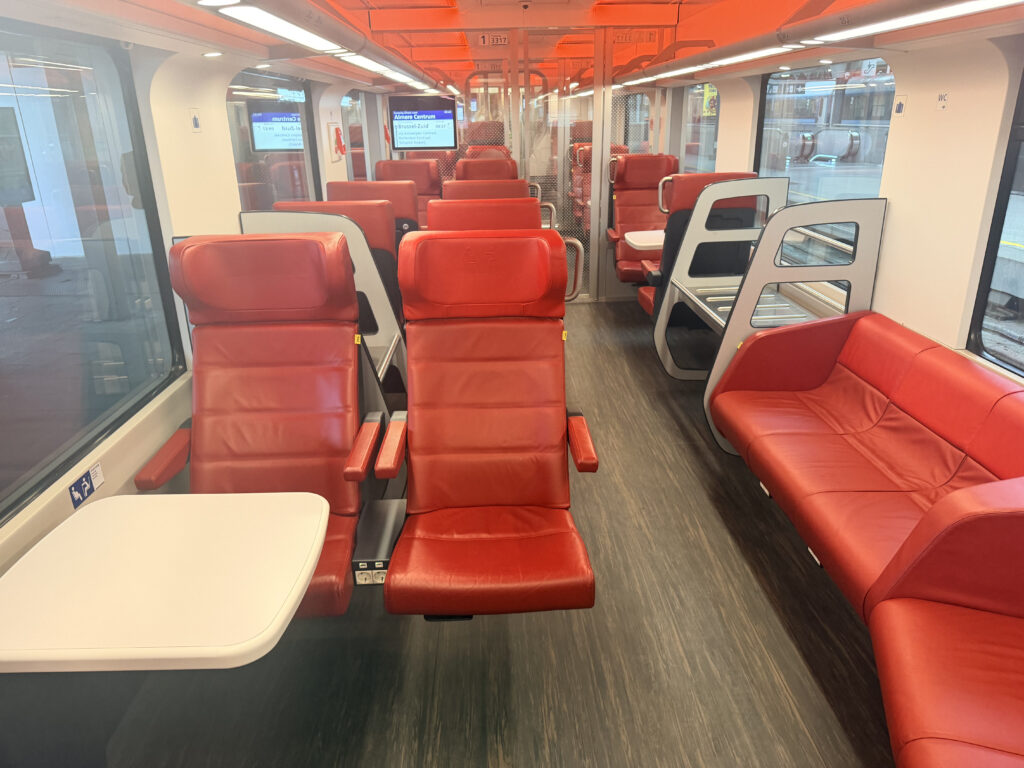
I initially took one of the solo seats, which felt very spacious. Upholstered in a bright red leather that is bold, comfortable and felt durable, each seat offers USB-A and European power sockets.
Wheelchair spaces are available on board. And accessible seats are sensibly installed close to the doors to minimize the walk for passengers with reduced mobility.
Overall, the cabin felt cosy and intimate despite the bare white walls. The very wide windows and doors add to the sense of space and airiness.
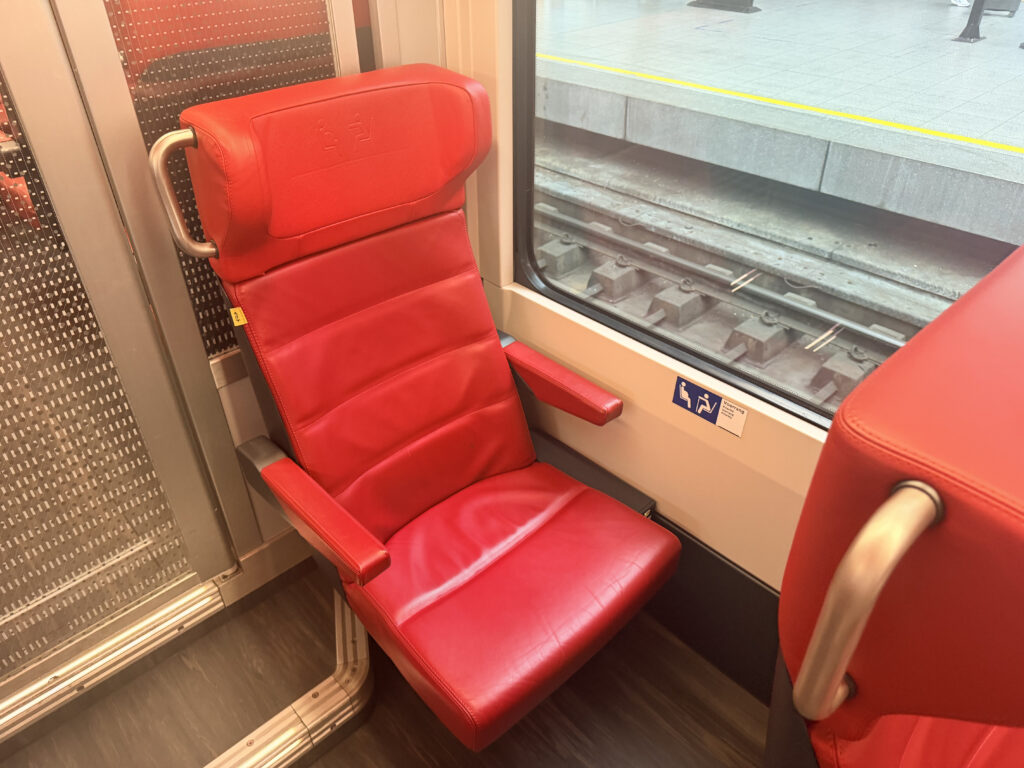
Functional and somewhat conservative, the interior is nonetheless well-appointed and highly practical. It is, dare I say, a very Dutch product (naturally, bike space is very generous).
The seats do not recline, but both armrests are adjustable. As the train departed Brussels Midi, I tried to connect to the Wi-Fi, but it did not appear to work. I managed to log on once we crossed the Dutch border. Fortunately, as ever, I had loaded entertainment onto my phone. My domestic 5G connection also worked very well throughout.
Shortly after departure, I moved from a solo seat to a table seat in one of the elevated sections above the bogies (wheel assemblies), which can be reached by a couple of steps.
While the ride quality became bumpier directly above the wheels, the view from the window was simply excellent.
Visiting the bathroom to inspect the facilities, I found them to be perfectly clean, spacious and easy to use —a stark contrast to Eurostar’s bathrooms with their limescale buildup and chemical flushes.
However, the lav design is curious, with vinyl tree-and-leaf wrap inside and a fake mosaic outside. It felt a bit tacky in comparison to the minimalist, industrial design of the rest of the train, but this might be your thing, if you like a room with a ‘view.’
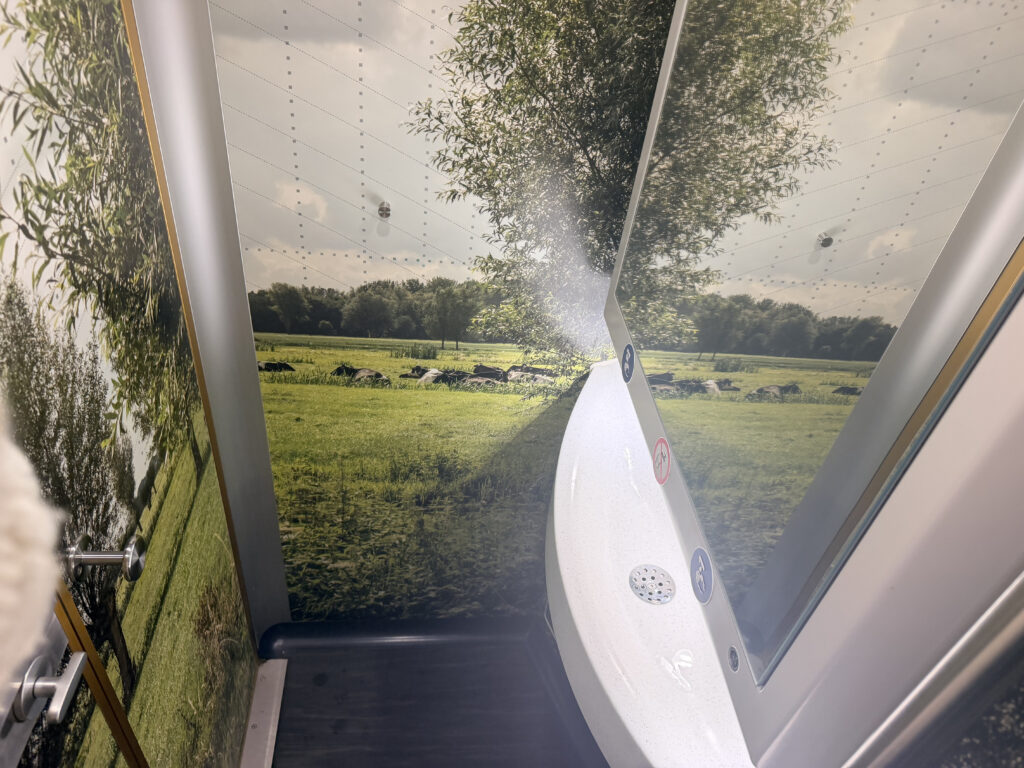
The train made a pickup stop at Antwerp in northern Belgium, where it filled up; passengers were soon standing in the second-class compartments.
Although the Alstom ICNG trainset did not exceed 125mph and remained closer to 100mph for much of the run from Antwerp to Rotterdam on the high-speed line, it became noticeably bumpy and the overall ride quality declined. This appeared to be a byproduct of the train’s design, with passengers sitting more directly above the bogies than they would in some other high-speed trainsets. Nevertheless, it was tolerable.

On the one-hour-20-minute journey, there was no onboard food and beverage service of any kind, as it’s simply not offered on NS trains, and the Wi-Fi, once connected, was quite slow.
Nevertheless, the ride was comfortable and quiet, and the overall experience felt relaxing.
The train arrived on time into Rotterdam. It should be noted that while it was scheduled to continue farther into the Netherlands, it was cancelled beyond Rotterdam for reasons that were not made clear over the public address system. That was an annoyance for other passengers, but for my purposes, I was perfectly happy with the experience.
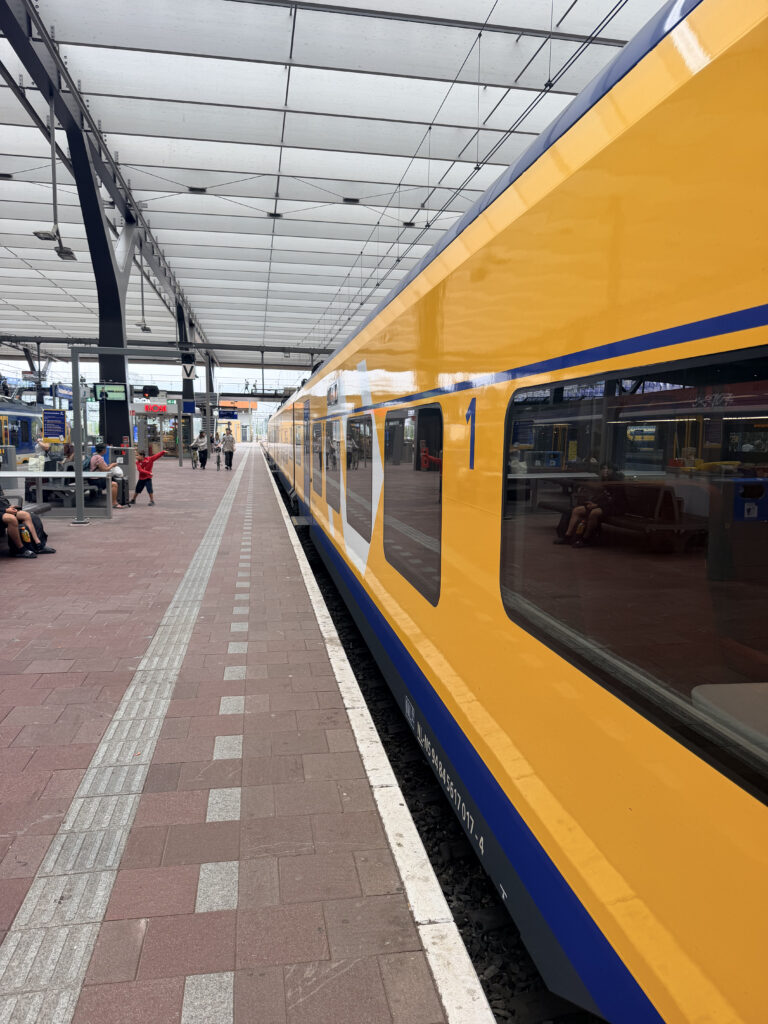
As I left the train and entered the airy palace of Rotterdam Centraal’s train sheds, I reflected on how EuroCity Direct compares with Eurostar. My first-class saver ticket cost €60, around €50 less than the equivalent Eurostar Plus product.
For that difference, the train took only ten minutes longer than Eurostar, but offered a much better seat: more comfortable, more modern and more spacious. It also provided a more inviting interior that felt cleaner, cosier and, bluntly, more pleasant to spend time in.
The toilet was better too, and was not a chore to use. However, no food or beverages were offered on board. And, there was no opportunity to earn loyalty benefits as a regular traveller would on Eurostar. Additionally, Eurostar Plus tickets are flexible and can be rebooked without a penalty.
Overall, from the perspective of a passenger making a day trip to Rotterdam, EuroCity Direct proved to be a significantly more attractive product, irrespective of the benefits missing compared with Eurostar.
Above all else, I hope that this worthy competition will motivate Eurostar to refresh its service.
Related Articles:
- Lyon-Paris Frecciarossa business class: a worthy TGV challenger?
- Trenitalia’s Frecciarossa Executive proves delightfully decadent
- How TGV Duplex sets the pace for first class train travel
- New logo, same train: a Eurostar Standard Premier review
- Chunneling to London: Eurostar is smooth, quiet and good value
- Flagging accessibility as EU eyes cross-border rail through-ticketing
- Ouigo high-speed rail proves fuss-free on Paris-Bordeaux
All images credited to the author, Fintan Horan-Stear