


Low Earth Orbit (LEO) satellite operators and their low-latency services are shaking up traditional business models. The disruptive forces at play are numerous: many operate their own ground segments as part of a vertically integrated model. And in aviation, where aircraft operators are moving with speed to adopt LEO-only and multi-orbit inflight connectivity, new antenna and modem architectures have emerged for which standards have not yet been developed.
But for ST Engineering iDirect, a leading global provider of gateways, hubs and indeed IFC hardware including aero modems, this inflection point in industry is “a glass‑half‑full moment” for all markets that rely on satellite communications.
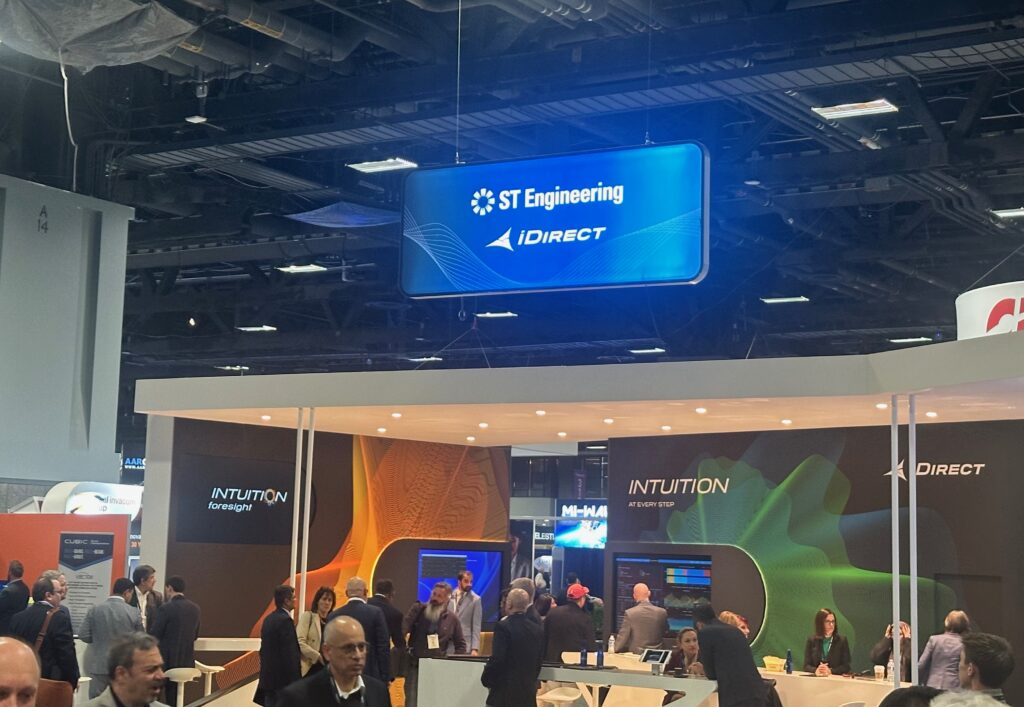
The firm’s new Intuition Foresight solution is a perfect example of the dizzying pace of change in industry, and how ST Engineering iDirect is staying ahead of the curve. Unveiled at the big SATShow conference and exhibition in Washington D.C., Intuition Foresight is an advanced orchestration and management suite designed to deliver AI-driven network intelligence and unified control across multi-vendor, multi-platform, and multi-network environments.
Crucially, Intuition Foresight enables ST Engineering iDirect to use standard APIs to integrate LEO capacity into multi-orbit networks.
“We’re witnessing a fundamental shift in satcom. The industry is moving from bespoke, hardware‑centric programs to modular, agile, software‑driven networks. Our strategy reflects that shift — we’re building the tools that let operators modernize today while preparing for a fully interoperable, multi‑orbit future,” ST Engineering iDirect’s newly appointed CEO, Sridhar Kuppanna, told Runway Girl Network.
To put this shift into perspective, five years ago, no one was thinking about how to integrate a competitor’s capabilities. But today, interoperability is central to ST Engineering iDirect’s strategy because it’s clearly where the market is going.
“The future of satcom isn’t about any single network or orbit — it’s about how seamlessly they work together. Our role is evolving to orchestrate that convergence so operators and end users can move across networks effortlessly,” Kuppanna explained. And under this paradigm, the ground segment “is arguably more important than ever before.”
The real value of it is shifting rapidly to software — in orchestration, automation and intelligence across multi‑orbit, multi‑vendor networks. That’s where we’re investing, because that’s what delivers flexibility and efficiency for our customers.
In sync with this evolution, many of the hardware‑centric constraints that presently shape aviation connectivity are naturally expected to gradually fade as software‑defined, standards‑based approaches take hold.
That’s among the reasons why ST Engineering iDirect values alliances and joint innovation programs like Airbus UpNext, where it is working with other ecosystem partners to explore how software‑defined satellites can manage and optimize 5G NTN and standardized 5G UE modems. For commercial aviation, this work has the potential to simplify interoperability, improve operational efficiency, and ultimately deliver a better passenger experience.
“Aviation, maritime and mobility markets are demanding openness and standards. With Intuition, Intuition Foresight and our 5G NTN work, we’re enabling a world where networks and devices interoperate by design, not by exception — and that’s what finally unlocks scale,” said Kuppanna.
RGN sat down with management at SATShow (also known as SATELLITE) to understand how Intuition Foresight will change the game and enable an unprecedented amount of flexibility for satellite operators and ergo, their customers, including airlines. Please enjoy our interview.
RGN: The launch of Intuition Foresight comes at a time when we’re seeing robust demand for multi-orbit connectivity pipes in maritime and increased adoption of multi-orbit inflight connectivity in aviation. Why does Intuition Foresight make sense for stakeholders serving the mobility vertical, specifically? What is its value proposition to those who serve the satcom needs of ships and planes?
ST Engineering iDirect: Intuition is a portfolio of products and services, Intuition is the master product brand. Intuition Core, launched in 2024, is our next generation satcom groundsystem with new capabilities including cloud-native, multi-orbit enabled, and security, and edge devices to access the network. Last year, we introduced Intuition Unbound, our as-a-service offering.
Now with Intuition Foresight we’re introducing the orchestration and management layer the market has been asking for — a multi‑faceted, AI‑driven control environment that enables true multi‑orbit, multi‑vendor operations. It can manage all iDirect networks, including non-Intuition platforms, as well as third-party networks giving operators a single, scalable management framework at a time when terrestrial convergence is accelerating.
For mobility markets where ships and aircraft rely on dynamic, multi‑orbit connectivity, Foresight delivers the unified visibility, automation and intelligence needed to maintain consistent service quality as conditions change. It takes the operational burden off service providers and gives them a standards‑aligned, future‑proof way to orchestrate complex networks with far greater efficiency.
RGN: That somewhat answers my next question, but for full clarity, do I need to be a customer of Intuition to avail of Foresight? Or, if I’m a customer of [advanced hub system] Velocity, for example, is there a way to use it?
ST Engineering iDirect: Solutions need to interoperate. Many of our customers run more than one of our existing platforms, and they may not be ready to deploy a new Intuition Core architecture. But every customer is ready to modernize. It’s simply not efficient to operate two or three networks running independently, where every configuration change or event requires manual intervention. Intuition Foresight creates a true “single pane of glass” — bringing network management, service management and AI operations together across all those existing environments without requiring Intuition Core. Whether a customer is using Dialog, Velocity Evolution or Evolution Defense, Foresight lets them modernize immediately with advanced network intelligence and automation on the platforms they already have.
Our customers also want to integrate LEO capacity, which is so far only available through vertically integrated vendors. With Intuition Foresight using standard APIs, we can integrate the LEO network. And the reality is that many customers want or need dual-vendor solutions for supply chain management and derisking, or simply to offer more services. Intuition Foresight can also integrate third-party vendors — our competitors — to manage across vendors.
Our goal continues to be the development of standards-based solutions that can manage complex networks to be ready for the eventual 5G NTN 3GPP solution. We’re still focused on serving our core customers and our core markets, but we’re also moving up a layer to set the stage for increasingly complex network integrations that help our customers operate more efficiently and more effectively.
RGN: That’s interesting. When you mention multi-vendor, there’s a big question now in aero as to whether that might ultimately happen. It’s happening everywhere else, cruise being a prominent one. You guys are laying the groundwork anyways to be prepared for any eventuality across the verticals that you’re supporting?
ST Engineering iDirect: That’s correct.

RGN: Okay, very good. Last year, ST Engineering iDirect inked an MOU with SES at this show. Has that been finalized? And if so, will the agreement cover adoption of Intuition Foresight?
ST Engineering iDirect: The MOU was finalized and signed then. We’ve been working with them since then on various go-to-market strategies. We have regular conversations with them on what the future may bring, but we don’t have anything definitive yet to share.
Having just launched Intuition Foresight, we are in the process of demonstrations with all of our customers. It’s been incredibly well received. We’re partnering with customers — we did a recent announcement with Q-KON — so that we’re using live networks and real data. During the SATELLITE show, many customers expressed the desire to engage. We expect that interest from global and regional operators and service providers will continue for the foreseeable future.
RGN: So is your role evolving then, almost as an orchestrator?
ST Engineering iDirect: The role is absolutely evolving. Traditional ground‑system vendors built a platform, deployed it, and customers ran it largely unchanged for decades. That model doesn’t match the realities of today’s market. Our value now is in enabling seamless connectivity for end users and seamless operations for our partners, regardless of orbit, vendor or access technology.
We will continue to supply the ground segment, but increasingly our role is to orchestrate how networks work together — making it simple for customers to switch between networks, integrate new capabilities, and operate at a scale that wasn’t possible before. It’s a fundamental shift in how we see our place in the ecosystem.
RGN: During a general session at SATShow, panelists were asked: “Considering the increasingly sparse RF spectrum availability, how do you expect laser comm technology to change the satcom ground segment.” Can ST Engineering iDirect answer the same question, sharing its perspective?
ST Engineering iDirect: We’re seeing far more satellites on orbit, especially LEO, and that growth drives a corresponding increase in gateways, which in turn consume more RF spectrum. Optical links offer one way to relieve that pressure. Laser communications avoid many of the regulatory and coordination challenges associated with RF and can deliver very high‑throughput, low‑probability‑of‑intercept links. But for space‑to‑ground, laser technology still faces real constraints: atmospheric conditions, weather, cloud cover and turbulence all introduce variability that must be mitigated before it can become a mainstream replacement for RF.
Where we see more near‑term impact is in space‑to‑space optical links, which can enhance sovereignty and resiliency by moving data across constellations without relying on gateways in geographically or politically constrained regions. Over time, we expect hybrid RF‑and‑optical architectures to emerge, with RF remaining essential for ground connectivity and optical augmenting capacity where it makes sense.
RGN: IFC communication networks are typically not inter-operable, requiring proprietary modems and other customized characteristics. According to the Seamless Air Alliance, 3GPP NTN brings an opportunity to “harmonize IFC standards, moving away from proprietary solutions that limit growth, prevent technology upgrades, and inhibit interchangeability of equipment.” During SATShow, ST Engineering iDirect is notably showcasing a live demonstration, highlighting native 5G NR-NTN access interfaces with a 5G core, “enabling seamless interoperability with terrestrial networks as well as other 3GPP and non-3GPP NTN systems supporting advanced 5G applications.” Will this work also help to advance 5G applications in aero?
ST Engineering iDirect: Yes. The first step was enabling non‑3GPP systems to access the 5G Core, which is essential in aviation where hundreds of thousands of certified terminals are already flying and can’t simply be swapped out. The next step was establishing native 5G NR (new radio)‑NTN interoperability between a 5G UE (user equipment) and the 5G Core. That’s critical because standardized, commoditized user equipment is what ultimately unlocks scale, revenue potential and true integration with the broader mobile ecosystem. Without that standardization, every operator ends up with a proprietary solution, and the industry never achieves the economics or upgrade path that mobile wireless enjoys.
Over time, aviation will need to converge on common devices and even common waveforms. Airlines want that flexibility, and it requires a standards‑based approach.
RGN: And then I hit you with a hardware question: is ST Engineering eyeing the possibility of supplying a 3GPP NTN standard model in aviation?
ST Engineering iDirect: Yes, we have a roadmap that has 5G NTN capabilities for aviation. We’re also exploring 5G NTN type onboard processing for satellites, because we see the need for end-to-end capability across the ecosystem.
On our US government side, we’ve already developed a software defined modem — the 450SDM — that runs multiple waveforms today. That approach to interoperability could have a play in how commercial aviation moves between networks in the future. Although, we are primarily focused on commoditized hardware for commercial markets, including aviation. The real value in all scenarios is software coupled with orchestration and intelligence to seamlessly interoperate. Certainly, that is how we unlock scale for 3GPP NTN in aviation.
RGN: So hardware, in many aspects, across the value chain, is commoditized now?
ST Engineering iDirect: Not yet, but it needs to move in that direction industry-wide if we want to scale. Look at how easily network devices or mobile phones have scaled with common chip sets. Operators and service providers buying standards-based products will create the scale we need to drive down cost and increase the user base. Foresight allows satcom to move from bespoke, monolithic programs to modular, agile, multi‑vendor solutions — exactly what airlines are asking for.
Related Articles:
- SES meoSphere will be core to new MEO/LEO inflight connectivity
- How Quvia helps airlines throw out the IFC playbook and take control
- Intellian advances ESA for Panasonic, reveals further aero aspirations
- Optimism abounds as Amazon eyes more open ecosystem for LEO
Featured image credited to istock.com/ipopba