

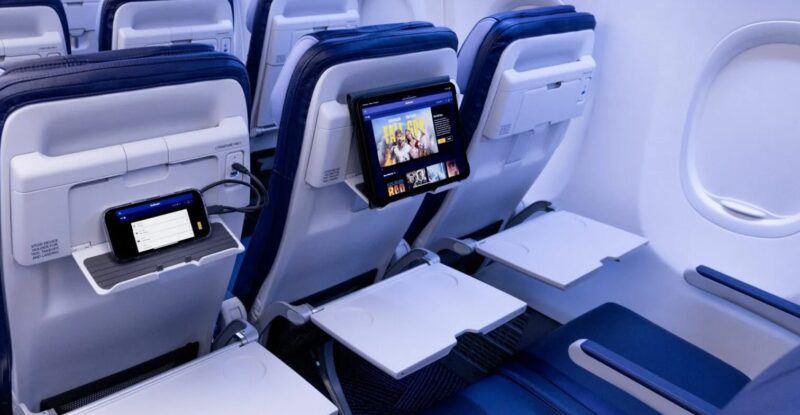

Southwest Airlines plans to integrate SpaceX’s Starlink Ku-band Low Earth Orbit (LEO) satellite-powered inflight connectivity into its fleet.
The decision is impactful. Anuvu, which is now owned by Platinum Equity, has long supported Ku-band Geostationary (GEO) satellite-based IFC and live television on Southwest’s all-Boeing 737 fleet, including under the name Global Eagle and before that as Row 44. And it recently brought new MicroGEO capacity on line, as Southwest started offering T-Mobile-sponsored free Wi-Fi to loyalty members.
Viasat, meanwhile, was tapped in 2022 by Southwest to bring its high-capacity Ka-band IFC solution to the carrier’s new jets, with the system factory-installed at Boeing. Viasat’s kit will remain in play on fitted aircraft, Southwest confirms to RGN. The carrier’s Starlink announcement does not impact its existing commitments to Viasat.
The siren call of low-latency LEO IFC is, however, clearly proving hard to resist, as indeed is SpaceX’s Starlink proposition, which has attracted a raft of airline customers including but not limited to Air France, airBaltic, Alaska Airlines, Emirates, Korean Air and its Hanjin Group airlines, IAG Group, Lufthansa Group, Qatar Airways, SAS, United Airlines, WestJet and Virgin Atlantic.
“Starlink delivers that at-home experience in the air, giving customers the ability to stream their favorite shows from any platform, watch live sports, download music, play games, work, and connect with loved ones from takeoff to landing,” Southwest EVP, chief customer & brand officer Tony Roach explains in a statement.
The airline plans to “rapidly integrate” Starlink into its fleet, with the first fitted aircraft slated to enter revenue service this summer. Some 300 aircraft retrofits are expected to be completed by the end of 2026.

“We’re thrilled to deliver a connectivity experience to Southwest Airlines and its customers that really is similar, if not better, than what you can experience in your own home. Starlink is the future of connected travel, making every journey faster, smoother, and infinitely more enjoyable,” says Jason Fritch, VP of Starlink Enterprise Sales at SpaceX.
Other LEO services have seen gains as well. Elsewhere, Eutelsat OneWeb’s Ku-band offering is being combined with GEO to support resilient multi-orbit LEO/GEO IFC solutions, such as those on offer from Hughes Network Systems, SES and Panasonic Avionics. And OneWeb will soon power LEO-only options for airlines from Immfly and Hughes.
Amazon LEO, formerly known as Amazon Kuiper, is moving with speed to build out its Ka-band LEO network to support multiple verticals, including IFC. Today, it launched 32 satellites on Arianespace’s Ariane 64 heavy-lift rocket.
Related Articles:
- Viasat sees future opportunities to renegage with Starlink customers
- How Telesat plans to differentiate in LEO with Lightspeed
- SES flags risk when airlines ‘hand over the keys’ to Starlink
- Southwest Airlines shows its love with free Wi-Fi
- IAG taps Starlink to power inflight Wi-Fi for 500-plus aircraft
- Anuvu MicroGEO satellites now operational over the United States
- Lufthansa Group to retain current IFC until Starlink pivot is complete
Featured image credited to Southwest Airlines