

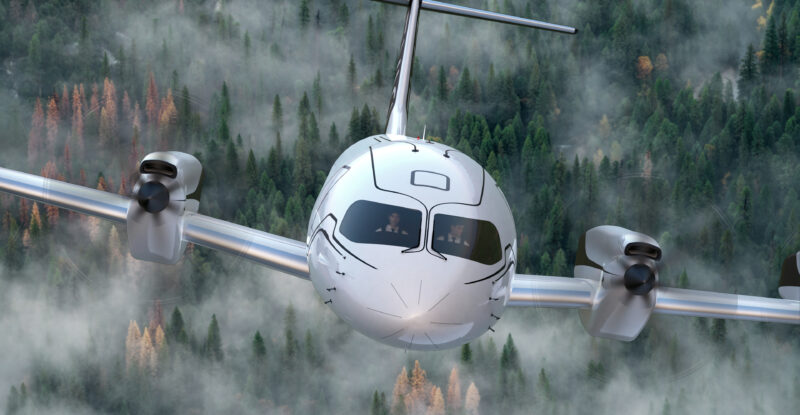

 A Canadian start-up backed by Boeing and Pratt & Whitney Canada aims to “change the face of aviation” with a hybrid-electric regional aircraft that promises to reduce emissions, slash maintenance costs and improve the passenger experience when it enters service in the early 2030s.
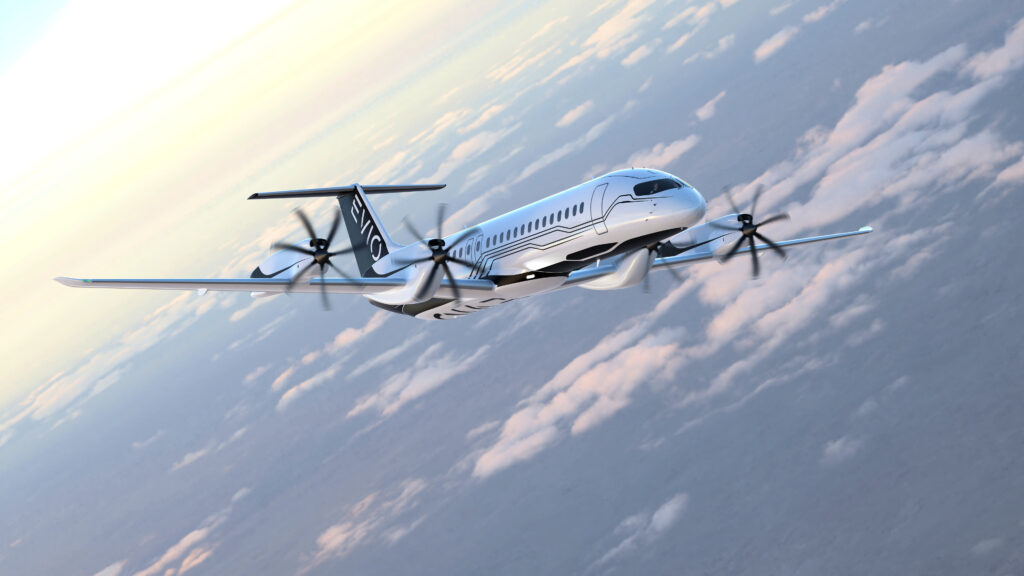
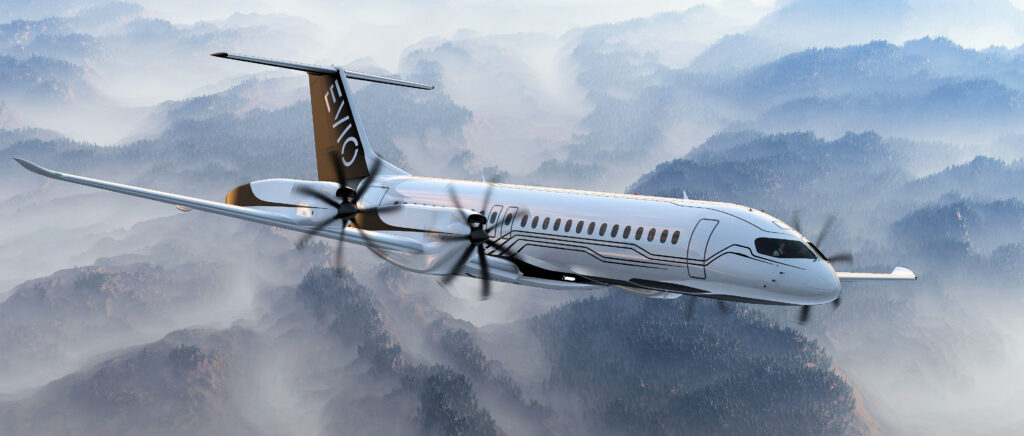
The under-development EVIO 810 is a 76-seat hybrid-electric aircraft that aims to “really disrupt the heart of the regional market that traditionally turboprops have shined exceptionally well in,” EVIO chief executive Michael Derman tells Runway Girl Network.
The aircraft will be powered by four wing-mounted Pratt & Whitney Canada PT6 turboprop engines linked to electric motors and will be capable of flying up to 100nm (185km) on battery power alone, says Derman.
Marketed as a “strong hybrid,” the EVIO 810 will operate in all-electric mode for taxi, takeoff and climb on all missions. On longer flights of between 100nm and 500nm, the aircraft will go into hybrid mode and the turbines will kick in.
“Every year, as improved batteries come out, the [all-electric] range increases, as do emissions reductions on our longer-range missions,” says Derman. “Over time, this aircraft every year becomes a more valuable asset when comparing it to a legacy platform.”
Having waited until late last year to publicly launch its aircraft, EVIO joins a growing list of start-ups that had already announced plans to develop hybrid-electric regional aircraft. Among these are Heart Aerospace, which is developing a 30-seat hybrid aircraft with an all-electric range of 200km and a certification target of 2029; Maeve Aerospace, which is developing a 76-100-seat jet with two hybrid-electric powerplants; and Aura Aero, which is developing a 19-seat hybrid-electric commuter jet.
In addition to this, ZeroAvia is developing hydrogen-electric powertrains for the 10-20-seat and 40-80-seat regional aircraft markets, while Deutsche Aircraft is using the Dornier 328 platform to develop the D328eco — a 40-seat regional turboprop billed by the company as “the most advanced, energy-efficient and cost-effective regional aircraft on the market.” Meanwhile, turboprop manufacturer ATR is working under the European Union’s Clean Aviation program to fly a hybrid-electric regional aircraft based on the ATR 72-600 by 2030.
But Derman appears unfazed by the competition, noting that EVIO’s program has been in the works for seven years and was operating in “stealth mode” while it explored and discounted various approaches.
“First, we played with the idea of modifying an existing turboprop and we could not make the economics pencil out for an operator,” says Derman. “Then we looked at a mild hybrid, where you modify an existing platform and use electrification to boost taxi, takeoff and climb, and we looked at a clean-sheet mild hybrid approach, but we still couldn’t get the economics to pencil out.
“So, then we went to what we call a strong hybrid, where you could do on a short-range mission gate-to-gate all-electric and use your turbines for extended range. In that scenario, the economics start to make sense.”
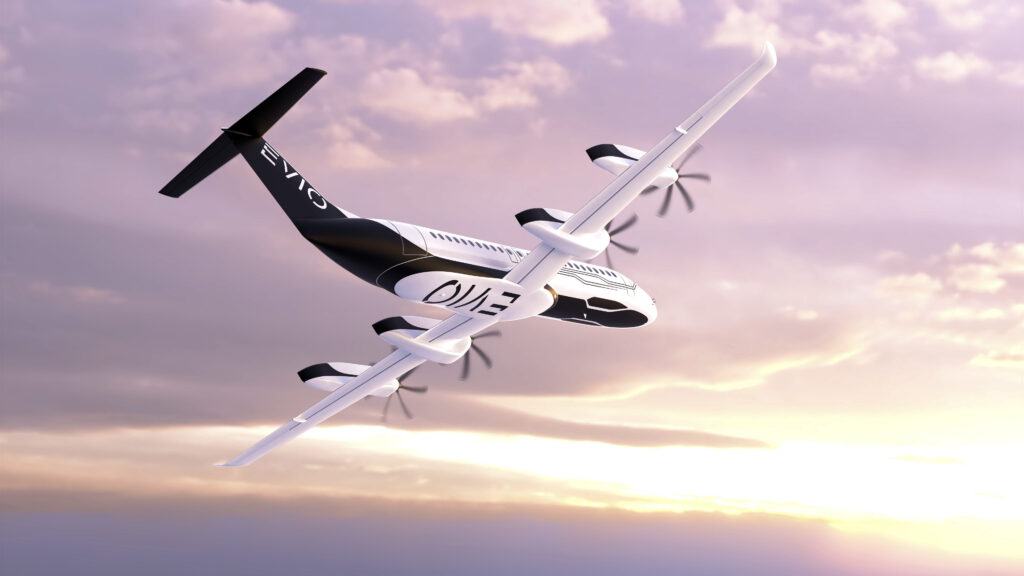 However, he adds that EVIO “took it another step further than any of our competitors” by “using the turbines in a novel way that provides unmatched economics on the maintenance side.”
Derman declines to elaborate on how its “proprietary design” will shave maintenance costs, but notes: “We really wanted to drive down maintenance costs, which is a very big piece of the pie when it comes to operating cost for an airline. It’s not just the fuel reduction; it’s the servicing of the aircraft.”
The start-up is confident there is enough market demand in the regional aviation segment, noting that regional operators have found it difficult to make the economics work with the aircraft that are currently available, resulting in the loss of more than 2,600 shorter-range routes in recent years.
“We’re tackling this first and foremost from an operator economics standpoint; to be able to make not just existing routes ones that are profitable but also being able to stimulate closed routes and have operators bring those back as well,” says Derman.

EVIO has received conditional purchase agreements for 250 of its hybrid-electric aircraft from two unnamed airlines plus options for an additional 200 aircraft. Derman says they are “globally recognised major airlines with regional connectivity” but declines to provide further details until the prospective customers are ready to make a launch announcement.
“The numbers that we have obtained in orders is a record for a new regional aircraft program, historically speaking,” he notes.
Aside from reducing emissions and maintenance costs, Derman says that improving the passenger experience was also “very important to us.”
With a fuselage width of more than 10ft in diameter, the EVIO 810 is “wider than today’s current regional jets,” he notes. This means the seat width will be “on par with an Airbus A220” and there will be extra space for overhead bins. The aircraft will also include a lavatory that is designed for persons with reduced mobility — a factor which Derman says is “very important for us.”
“We want to be able to give everyone an exceptional experience and it’s not just the lavatory or the seat, it’s also the noise level,” he says. “We have done things to reduce the acoustic signature of our propulsion system inside the cabin.”
 Boeing is providing both investment and technical support to EVIO, which Derman says “helps de-risk the program.” The US airframer has agreed to invest an undisclosed sum in the start-up. When it comes to additional funding, Derman says that “we will be rolling that out with our partners” in the future.
Montreal-based EVIO is in the process of selecting a site on which to build its production facility. Canada “certainly has a leadership position here,” says Derman. He declines to disclose whether sites in the USA are also under consideration, but says the company expects to make a decision on the location of the site this year. The facility “has to be able to support a production rate of over 100 aircraft a year, at a minimum.”
EVIO aims to launch its flight-test program before 2030 and plans to get its propulsion system on a test stand later this year. Service entry for the aircraft is targeted for the early 2030s.
Related Articles:
- ATR sees strong U.S. market potential as JSX showcases ATR 42-600
- JetZero to bake wheelchair accessibility into Z4 interior
- Eve Air Mobility CCO Megha Bhatia on what sets its eVTOL apart
- Airbus hones hydrogen plan, showcases next-gen narrowbody tech
- ZeroAvia CEO Val Miftakhov reveals plan for possible IPO in 2026
All images credited to EVIO