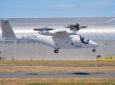


 Eve Air Mobility (Eve), a company dedicated to the development of a suite of solutions for the Urban Air Mobility (UAM) market, including an electric vertical take-off and landing (eVTOL) aircraft, completed the first flight of its uncrewed full-scale eVTOL prototype at Embraer’s test facility in Gavião Peixoto, state of São Paulo.
The inaugural flight initiates Eve’s flight test phase and confirms the integration of key systems, including the fifth-generation fly-by-wire concept and the fixed-pitch lifter rotors. The company will perform multiple flights following today’s hover flight, gradually expanding the envelope to transition into full wingborne flights throughout 2026.
“Today, Eve flew. This is a historical milestone for our employees, customers, investors and the entire ecosystem,” said Johann Bordais, CEO of Eve. This flight validates our plan, which has been executed with precision to deliver the best solution for the market. We were able to capture high-fidelity data that will allow us to move forward with safety and confidence towards the certification path.”
Eve will manufacture six conforming prototypes to conduct the flight test campaign, aiming for certification. The Company continues to engage with Brazil’s Civil Aviation Agency (ANAC), Eve’s eVTOL primary certifying authority, to advance the certification process. Looking ahead, Eve expects type certification, first deliveries and entry into service in 2027.
“We exercised our control laws, verified the integration of the eight lifters and assessed energy management, the aircraft’s dynamic response and noise footprint,” said Luiz Valentini, Chief Technology Officer at Eve. “The prototype behaved as predicted by our models. With these data points, we will expand the envelope and progress toward transition to wingborne flight in a disciplined manner, ramping up to hundreds of flights throughout 2026 and building the knowledge required for type certification.”
“This flight gives the product a clear green light to advance what matters to operators: reliability, efficiency and simplicity,” said Jorge Bittercourt, Chief Product Officer at Eve. “We validated critical elements, from our lifter architecture to aircraft flight mechanics, and now we move into the flight test phase, aiming to advance the product maturity.”
Next steps for the program include progressive envelope expansion and transitions to wingborne flight, as well as continued engagement with ANAC, other regulators and validating authorities, including FAA and EASA.
Eve leverages Embraer’s 56 years of aerospace expertise in designing, certifying, manufacturing and delivering state-of-the-art aircraft, as well as the company’s global aftermarket service footprint. Eve continues to focus on safety, simplicity and dispatchability to meet operator needs at scale.

About Eve Air Mobility
Eve Air Mobility is dedicated to accelerating the Urban Air Mobility (UAM) ecosystem. Benefitting from a start-up mindset, backed by Embraer’s 56-year history of aerospace expertise, and with a singular focus, Eve is taking a holistic approach to progressing the UAM ecosystem, with an advanced eVTOL project, comprehensive global services and support network and a unique air traffic management solution. Eve is listed on the New York Stock Exchange (EVEX; EVEXW) and the São Paulo Stock Exchange (EVEB31), where its shares of common stock and public warrants are traded.
Forward‑Looking Statement
Disclosure Certain statements contained in this release are forward‑looking statements within the meaning of the U.S. Private Securities Litigation Reform Act of 1995. These forward‑looking statements may be identified by words such as “may,” “will,” “expect,” “intend,” “anticipate,” “believe,” “estimate,” “plan,” “project,” “could,” “should,” “would,” “continue,” “seek,” “target,” “guidance,” “outlook,” “if current trends continue,” “optimistic,” “forecast” and other similar words or expressions. All statements, other than statements of historical facts, are forward‑looking statements, including, but not limited to, statements about the company’s plans, objectives, expectations, outlooks, projections, intentions, estimates, and other statements of future events or conditions, including with respect to all companies or entities named within. These forward‑looking statements are based on the company’s current objectives, beliefs, and expectations, and they are subject to significant risks and uncertainties that may cause actual results and financial position and timing of certain events to differ materially from the information in the forward‑looking statements. These risks and uncertainties include, but are not limited to, those set forth herein as well as in Part I, Item 1A. Risk Factors and Part II, Item 7. Management’s Discussion and Analysis of Financial Condition and Results of Operations of the company’s most recent Annual Report on Form 10‑K, Part I, Item 2. Management’s Discussion and Analysis of Financial Condition and Results of Operations and Part II, Item 1A. Risk Factors of the company’s most recent Quarterly Report on Form 10‑Q, and other risks and uncertainties listed from time to time in the company’s other filings with the Securities and Exchange Commission. Additionally, there may be other factors of which the company is not currently aware that may affect matters discussed in the forward‑looking statements and may also cause actual results to differ materially from those discussed. The company does not assume any obligation to publicly update or supplement any forward‑looking statement to reflect actual results, changes in assumptions or changes in other factors affecting these forward‑looking statements, other than as required by law. Any forward‑looking statements speak only as of the date hereof or as of the dates indicated in the statement.
Featured image credited to Eve Air Mobility