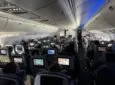



Passengers flying on several airlines across the Americas should expect to see reliably higher inflight Wi-Fi speeds now that Viasat’s ultra-high-capacity ViaSat-3 F2 (VS3 F2) geostationary satellite has officially entered service.
In the Americas, Viasat counts Aeromexico, Azul, American, Breeze, Delta, JetBlue, LATAM, Southwest and United among its customers.
“Rollout on VS3 F2 is already underway: several airlines are already connected with more onboarding each day,” Viasat told Runway Girl Network after announcing VS3 F2’s entry-into-service on September 17, and with it, the completion of its three-satellite ViaSat-3 constellation.
VS3 F2 joins the VS3 F1 satellite that has been supporting inflight connectivity on U.S. mainland-Hawaii routes, as well as VS3 F3, which entered service over Asia-Pacific in late August and has notably plugged a key gap in Viasat’s near-global coverage.
Together, the entire ViaSat-3 constellation triples the bandwidth available across Viasat’s fleet, giving the network more capacity, flexibility and resilience to meet growing demand for connectivity onboard planes.
Now, Viasat says it’s ramping up to have its entire VS3-enabled customer fleet connected “in the coming month or so.”
VS3 F3 is bellwether
Since VS3 F3 entered service over APAC, thousands of flights have availed of the Ka-band GEO satellite’s capacity and new tails are coming online daily.
Indeed, metrics from VS3 F3 usage serve as an indicator for what to expect with VS3 F2.
Viasat says:
VS3 F3’s advanced beam-forming steers bandwidth in real time to where demand is highest, so a full cabin gets capacity concentrated where it’s needed rather than spread thin, which matters more as passengers move from seatback screens to streaming and working on their own devices.
Early results? Service quality metrics are up across the board. Latency, availability, reliability, and speeds.
Some have improved by over 10x. Median peak throughput (i.e., typical consumption) is up 3x so far — a strong sign passengers are engaging more with the service.
Given that the lion’s share of its mainline fleet including international widebodies are fitted with Viasat’s IFC hardware, Delta will utilize all three high-capacity ViaSat-3 satellites to power its Delta Sync free Wi-Fi for loyalty members. That should equate to a far better experience for guests.
One might argue that VS3 F2 and F3 are hitting at just the right time, as some Delta passengers have vocalized consternation that the U.S. major’s service compares unfavorably to the SpaceX Starlink Low Earth Orbit (LEO) satcom solution rolling out across rival United’s fleet.

“The Viasat network is designed to address the growing demands of connected mobility, and aviation remains one of the clearest demonstrations of what that means in practice,” says Viasat Aviation president Don Buchman.
“The digital world has become a fundamental part of culture — how we communicate, work, socialize and relax. The ViaSat-3 constellation’s flexible, high-capacity throughput further enables passengers to behave online in the skies as they do at home, through a network capable of delivering both scale and resilience, now and well into the future.”
While speed is just one factor in high-quality IFC performance, passengers “should expect service quality metrics to go up across the board, including reliably higher speeds,” Viasat tells RGN.
Residential gets a boost as well
Also of note, pricing has come down for Viasat’s U.S. residential service and its Wi-Fi appears to be available in more areas. This is a direct result of VS3 F2 entering service.
Viasat reveals it will soon deliver “enhanced broadband performance for residential customers across the U.S. with improvements in customer experience,” while extending its reach to serve more markets nationwide.
Related Articles:
- Telesat restores commercial Lightspeed capacity with more satellites
- Airline passengers to benefit as ViaSat-3 F3 satellite enters service
- Amazon LEO to launch service this year, make aviation debut in 2027
- American pivots to Starlink for 500 narrowbodies
- Viasat sees future opportunities to reengage with Starlink adopters