

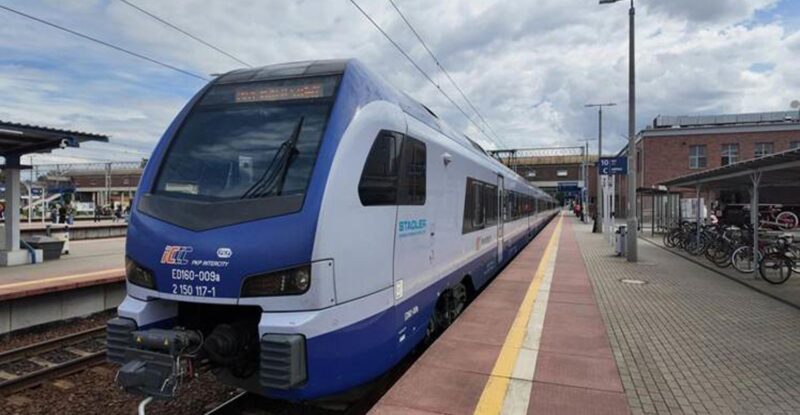
 Eutelsat has successfully completed its first rail connectivity trial in Poland aboard a long-distance train, demonstrating its OneWeb LEO connectivity capabilities on a live rail network.
The trial was led by ACO Solutions as the key systems integrator, with support from HispaSat as the distribution partner and Eutelsat. It was conducted aboard a PKP Intercity long-distance train travelling at speeds of up to 160 km/h on routes connecting Kozłów–Warszawa–Tczew.
The trial used the recently TÜV Rheinland rail-certified Kymeta Kestrel™ u5 terminal, engineered to meet the tough and demanding requirements of the rail environment. The Kestrel™ u5 is purpose-built for modern rail connectivity, featuring a high IP rating (IP69K) for durability and reliability, and optimised power consumption (averaging under 100W) for mobile platforms.
Eutelsat’s OneWeb LEO connectivity was tested for the first time on a live rail network in Poland, gathering performance data and assessing seamless switching between satellite and terrestrial technologies throughout the journey.
Designed to support both passenger and freight rail operations, Eutelsat’s rail connectivity solution combines its OneWeb LEO satellite connectivity with existing rail communications infrastructure to support passenger connectivity, operational communications and data services. The solution interfaces with onboard and trackside systems, helping rail operators enhance communications capabilities in the field while maintaining connectivity with operations centres across their networks.
Eva Bisgaard, President of Eutelsat’s Connectivity Business Unit, said: “The successful completion of our trial aboard a long-distance train is an important milestone for Eutelsat, demonstrating how our LEO connectivity can support both the passenger experience and increasingly digital rail operations. Our solution gives rail operators the flexibility to prioritise different connectivity needs and evolve as passenger expectations and operational requirements change. We look forward to bringing reliable, future-ready connectivity to rail operators across Europe and beyond.”
Joanna Siecińska, Member of the Management Board for Finance and Business Development at PKP Intercity, said: For PKP Intercity, the success of these tests is an important step toward providing passengers with a more reliable and seamless Internet connection throughout their journey. Thanks to the excellent cooperation between all project partners, we were able to validate this solution under real operating conditions and explore technologies that could further enhance onboard connectivity, passenger comfort, and the overall travel experience in the future.”

About Eutelsat