

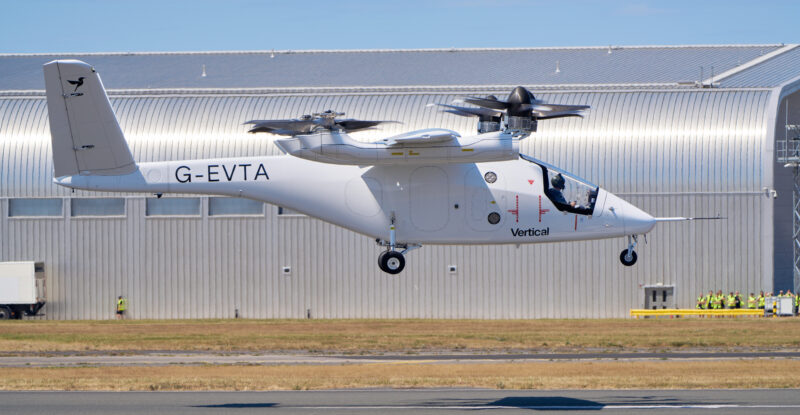

 With the company’s full-scale prototype making its flying display debut at Farnborough, RGN discussed the merits of Vertical Aerospace’s electric vertical takeoff and landing (eVTOL) tiltrotor with chief engineer David King.
Electric propulsion is a key component in aviation’s sustainable future but the eVTOL air taxi concept feels like the wrong starting point. Taking off and landing vertically takes a huge slug of energy from an eVTOL’s batteries, limiting range to the shortest of missions.
Battery technology will improve of course, but the resources and real estate required to operate eVTOLs from purpose-built inner city vertiports for the benefit of very few travelers seems counter to sustainability.
Using electric aircraft operating from existing runways at underused regional and rural airfields for journeys that otherwise rely on time-consuming rail or road travel, however, arguably delivers critical missing connectivity in a sustainable way.
Electric aviation was prevalent at July’s Farnborough International Airshow. New dual-use aircraft emerged as the eVTOL developers broaden their portfolios, while the term ‘hybridization’ slipped into conversations and press releases, tacit acknowledgement that for meaningful real-world range and payload, battery tech does not yet deliver.
The show was especially beneficial for Vertical Aerospace. It announced UK government production support, and defense interest in its hybrid-electric and autonomous developments.
It also flew its VX4 full-scale prototype in the daily display, achieving the show’s first ever eVTOL flight transitions from vertical to horizontal and back again.
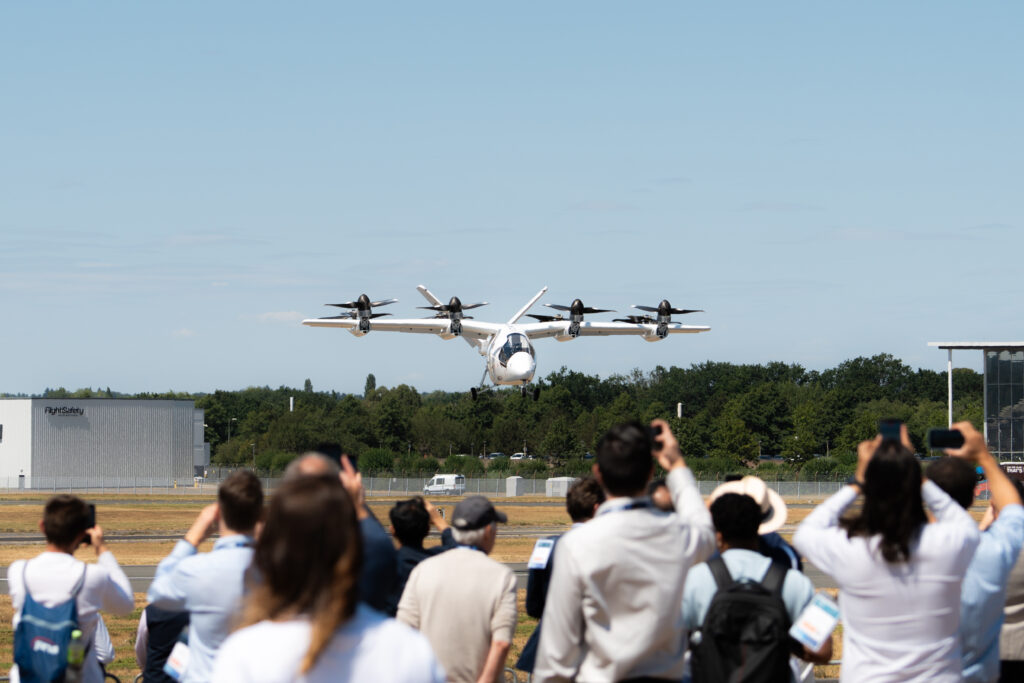
Vertical made its flying display debut on July 20, Farnborough’s opening day. The industry crowd was clearly impressed by the performance. Image: Vertical Aerospace
Yet the term ‘eVTOL’ seems too limiting for Vertical’s stable, accomplished electric tiltrotor. The machine spoke to my ideas on underused runways, thoughts I put to Vertical Aerospace chief engineer David King.
His response was robust: “Some companies are building versions of the same aircraft for eVTOL and eSTOL (short takeoff and landing.) I believe that if you build-in versatility you can then optimize for specific missions. We’ve designed one configuration that’s capable of taking off vertically when required but we know there will be lots of missions where STOL is possible, and others where it’s STOL at one end and VTOL at the other.
“It also means we don’t need massive infrastructure to start. We can use existing airfields and air traffic procedures. All we need at the airports we serve is charging equipment. We want customers to consider this as just another aircraft, which happens to be electric.”
Vertical designed its aircraft to transport-category safety standards from the outset and King revealed more about its philosophy. “We also said early on that to ensure passengers accepted it we didn’t want the aircraft to feel or sound like a helicopter because we know communities don’t always like them.”
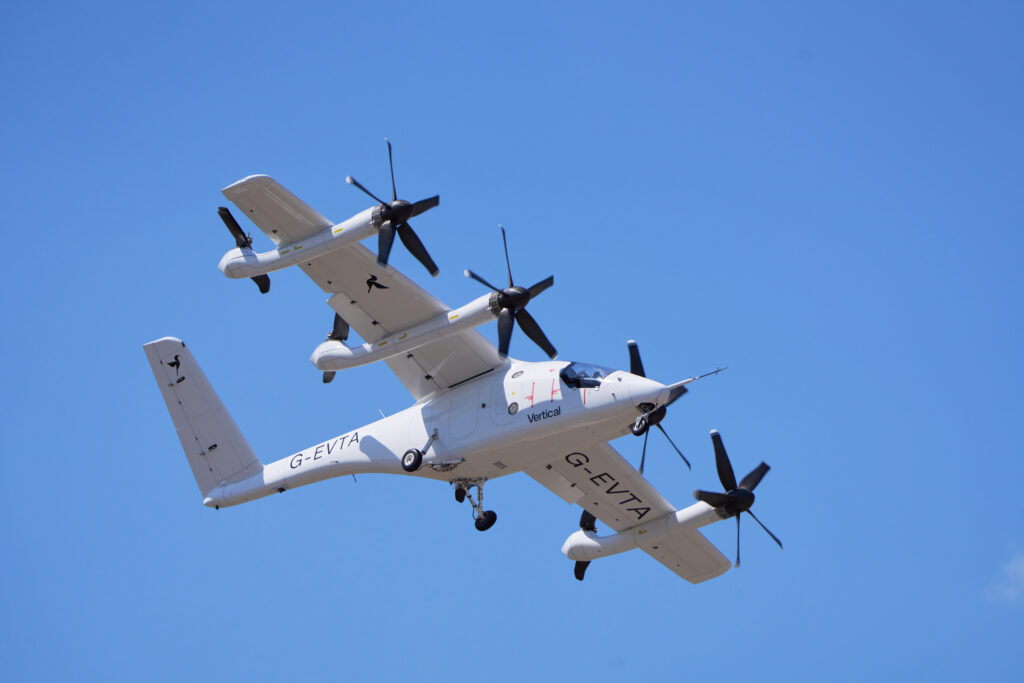
The opportunity to appreciate the aircraft’s quietness and its unique sound were lost to some extent within the commentary. It says much that from no more than a few hundred yards away, the aircraft could barely be heard. Image: Vertical Aerospace
Compared to a helicopter of similar four-passenger capacity, however, the need to carry batteries means Vertical’s prototype is obviously larger.
King explained: “We’ve oversized the design for four passengers, because that’s where our battery power density is now. But we’ve tested potential production cells over more than 4 million cycles in the lab. We’re already seeing a 15% improvement over those in our R&D aircraft, and they’ll be in production in four years, two years after the aircraft enters service.”

At that point, King envisages removing cells, reducing battery weight by 15% and increasing payload in a cabin which already has the necessary space for additional passengers. A sizeable luggage hold is also built in.
King believes a possible route to extended range is to sacrifice baggage space for a small turbogenerator. In the resulting hybrid-electric configuration, the electricity generated would recharge the batteries, meaning more power could also be used in critical flight phases.
King says the optimal range is 200 miles, which satisfies multiple UK regional routes. He highlights travel between the high-tech industrial and academic centers of Cambridge and Oxford, each with available runways. Thanks to the UK’s poor east-west connectivity, it’s a notorious journey taking around two and a half hours by car and at least 15 minutes longer by train. King says it is a one-hour, sustainable mission for Vertical, perhaps demonstrating the true potential value of electric aviation.
Related Articles:
- Norwegian electric flying boat developer NOEMI reveals wider scope
- ZeroAvia edges closer to cert as FAA issues electric engine conditions
- Archer prepares for eVTOL passenger flights as war looms over UAE plan
- EVIO details plan to disrupt regional market with hybrid-electric aircraft
- Eve Air Mobility CCO Megha Bhatia on what sets its eVTOL apart
Featured image credited to Vertical Aerospace