



 Thanks to the enthusiastic, pioneering team at Saxon Air, based out of the UK’s Norwich Airport, I’m flying in the Pipistrel Velis Electro, the world’s first type-certified electric-powered aircraft.
Saxon Air parks its Velis Electro under what is essentially a car port with a photovoltaic array for a roof. It supplies a Pipistrel charger so that on this bright April day we’re literally flying on the power of sunshine.
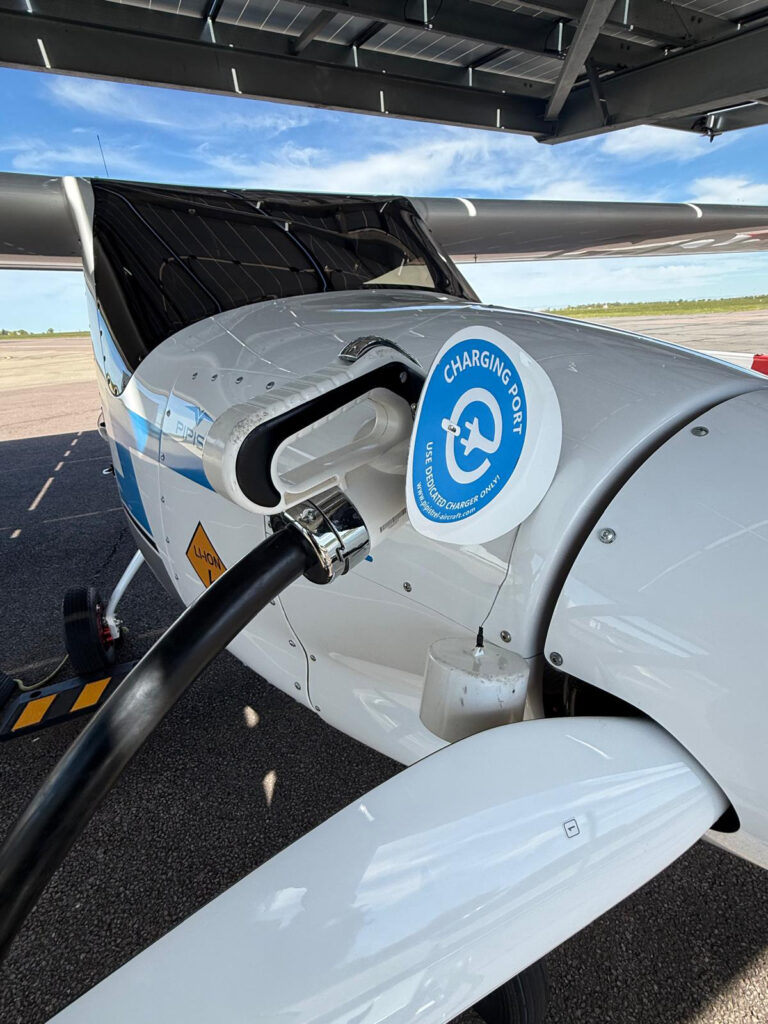
The Velis Electro drinks in the sunshine under Saxon Air’s charging port. Image: Victoria Macmillan Bell
Flight instructor Miles Riches, also Saxon Air’s head of rotary sales, briefs me on the aircraft, explaining how to get into the small cockpit and close the door.
Like a sports car stripped for outright performance, everything in the aircraft is lightweight, helping to maximize endurance from its batteries. Each door hinges up to a latch under the wing. A sharp tug frees it, and a handle moves three rods to lock it closed.
The rods nestle behind shallow cut-outs in the door frame. I expected draughts and rattles in flight, but the mechanism, like the rest of the airframe, is minimalistic but finely engineered, and there were none.
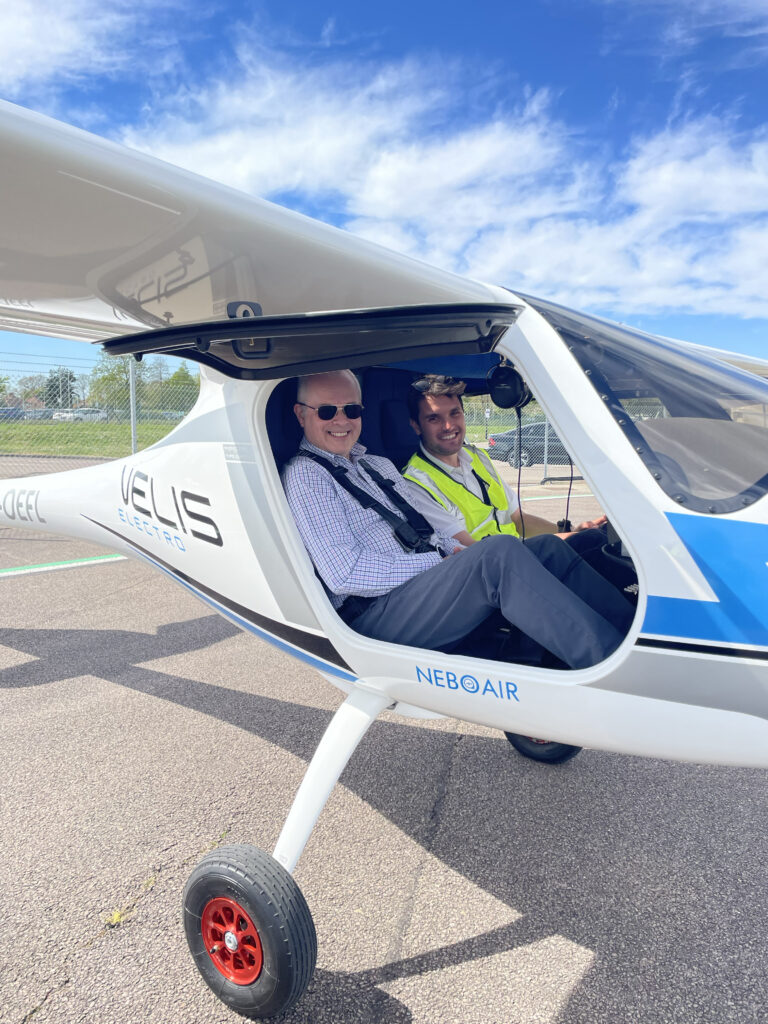
The Velis Electro cockpit is cozy for two people but comfortable enough for the aircraft’s limited endurance. Strapping myself into the right-hand seat, I was surprised to find a ‘squeezy air bladder’ – my term – which Miles explained was for lumbar support adjustment. Image: Letty Dell-Aquila/Saxon Air
The thinly-cushioned seats are deceptively comfortable. Batteries occupy the erstwhile baggage space of the piston-powered Velis models, leaving the electric-powered Velis Electro with no space for my laptop bag.
Miles opens the throttle and the propeller turns. He closes it, and the ‘prop’ stops. Since there is no piston engine ticking over or turbine whining at idle, the Velis Electro is silent.
A simple two-column bar graph-type display shows the charge capacity in each of the front and rear battery packs and how long the charge will last at the current power setting. Miles turns the aircraft into the wind on the taxiway to test the motor at full power…
…and it is immediately obvious any notion of taking off vertically makes a poor starting point for electric aviation. The energy bars turn red and the minutes of capacity remaining at that power level drop into low double figures.

Discernible below the map screen, the front and rear battery energy bars show 99% full charge and 58 minute’s endurance at 6kW, equivalent to around 8hp. When Miles opens the throttle fully, the motor delivers closer to 50kW (67hp), the energy capacity falls into ‘the red’ and the minutes of endurance remaining are barely in double figures. At more modest power settings, however, there is power in reserve for our 20-minute flight. Image: Paul E Eden
Take-off demonstrates the Velis Electro’s huge torque, the back-thumping immediacy of its power. As we climb out and turn into a wide right-hand circuit around the city of Norwich, the short take-off, combined with the extraordinary view from the aircraft’s huge windows, provides a helicopter-like experience, albeit without the vibration and noise.

We wear headsets so that Miles can communicate with ATC, but conversation without them is easy. The only noise comes from propeller wash and air flow around panels and airframe joints. It has been a while since I flew in a glider, but I suggest the cockpit noise levels are similar.
Miles says the glider comparison doesn’t end there. Where a piston pilot monitors temperatures and pressures, a Velis Electro pilot is concerned with energy management. For that reason, Miles is keen to learn more about gliding and believes that a student who learns to fly an electric airplane will likely be a more efficient pilot on anything else.
Approach is a little bumpy, but for a small machine the Velis Electro feels surprisingly stable.

On this warm day there are a few bumps on approach, but the Velis Electro gives the feeling of solidity one might expect from a larger, heavier airplane. Image: Paul E Eden
Miles taxis towards the charging port before cutting power and coasting to a stop. The clicks as we latch the doors open startle an airport worker standing maybe 100 feet away with his back to us — he hadn’t heard our approach.
Tipping the airplane back onto its mainwheels, Miles ‘wheelbarrows’ it the last few feet into the charging port, and plugs it in.

Saxon Air built the charging port on its own apron. Image: Victoria Macmillan Bell
Framing the Velis Electro only as an electric airplane masks its deeper potential. Yes, it reveals shortcomings to be overcome, primarily in endurance, but also heralds the dawn of a new flying experience.
It is quiet, making flying schools better neighbors, and I can’t think of a superior platform for short sightseeing flights. The aircraft is also cheap to operate because an electric powertrain requires little maintenance and, at least with Saxon Air, it runs on sunshine.

The University of East Anglia, photographed from the Velis Electro, demonstrates the aircraft’s sightseeing potential. Image: Paul E Eden
Related Articles:
- ZeroAvia edges closer to cert as FAA issues electric engine conditions
- Archer prepares for eVTOL passenger flights as war looms over UAE plan
- EVIO details plan to disrupt regional market with hybrid-electric aircraft
Featured image credited to Saxon Air