

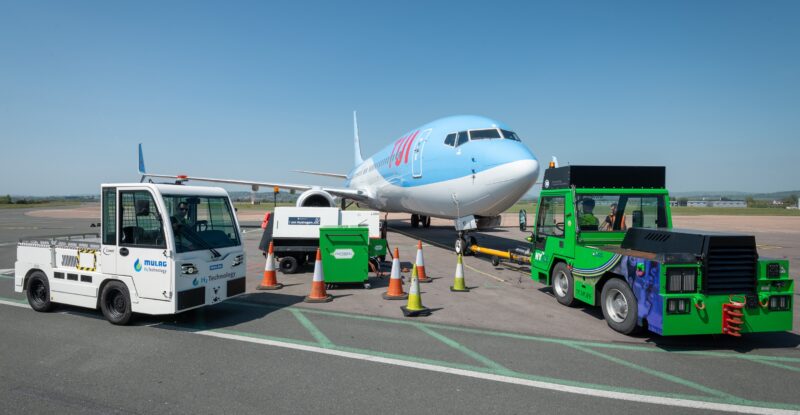

 Exeter Airport in the UK has become the latest to trial hydrogen-powered ground support equipment (GSE), with a second test currently underway following an earlier trial last April which used three different hydrogen technologies to support the turnaround of a TUI Boeing 737-800.
A spokesperson for Exeter’s operator, Regional & City Airports, tells Runway Girl Network that a second two-week trial, known as the HyGPU Winter Operations Project, is due to conclude at the end of this week. This latest trial, which is supported by Cranfield University, hydrogen fuel provider ULEMCo, transport accelerator Connected Places Catapult and the UK Civil Aviation Authority, involves testing a dual-fuel (hydrogen/diesel) ground power unit overnight and in cold, inclement weather conditions.
“Data will be collected and analyzed to determine the impact of varying ambient conditions on technical performance and operations,” says Exeter Airport. “This work will provide valuable technical insights on the use of hydrogen equipment under ‘real-world’ operating conditions, which will help inform future hydrogen applications and regulatory development.”
It follows a previous trial at Exeter Airport, which took place between 24 April and 2 May 2025, during which three separate pieces of ground service equipment – namely a dual-fuel GPU, a pushback tug powered by hydrogen internal combustion and a hydrogen fuel cell-powered baggage tractor – were deployed to support the live turnaround of a passenger-less TUI 737-800.
In a report published last month, Cranfield University said the April trial, known as the Zero Carbon Turn project, showed that hydrogen had the potential to help airports decarbonize their ground operations in the future. However, the trial also highlighted that “significant gaps” remain in understanding how to safely store and handle hydrogen in airport environments on a larger scale.
To help plug those gaps, the researchers argued, more trials are needed, and future demonstrations should be longer in duration and broader in scope.
“To prepare for hydrogen-powered aircraft and large-scale adoption of hydrogen GSE, the industry must expand research to further real-world conditions, explore storage and refueling approaches and formalize knowledge-sharing across the sector,” says Dr. Thomas Budd, an associate professor of airport decarbonization at Cranfield University.
While the Exeter project lays claim to being the first to test multiple hydrogen-powered GSE vehicles at the same time, it was not the first trial involving hydrogen at a European airport. In 2024, easyJet led an airside hydrogen GSE refueling trial at Bristol Airport in the UK. Project Acorn, as it was known, used hydrogen to refuel and power baggage tractors servicing the UK-based low-cost carrier’s aircraft.
Later that year, Austrian Airlines conducted a pilot program at Vienna International Airport, which involved the use of an H2Genset hydrogen generator to support regular ground maintenance of an Airbus A320 aircraft.

Each of these trials, say the teams behind them, is essential to build understanding of how hydrogen can be used safely and effectively in an airport environment in the future. The idea is that the results will feed into the development of a regulatory framework to support future hydrogen adoption at airports – both in terms of ground-based vehicles and to refuel hydrogen-powered aircraft, if and when they enter service.
For airports, zero-emission hydrogen presents an opportunity to pick some of the ‘low-hanging fruit’ when it comes to decarbonizing the operations that, unlike aircraft emissions, are very much under their control.
As the Cranfield report states: “While aircraft operations during landing and take-off (LTO) and emissions from passenger and surface access travel typically represent the highest share of Scope 3 emissions, these are also categories over which an airport typically has the least direct control.
“By comparison, airport ground operations are an area that can have a notable emissions profile (albeit smaller than aircraft and surface access), and where an airport may be able to wield a greater level of influence and decision-making power. This may be especially the case where an airport conducts its ground operations in-house, rather than outsourcing to specialist third party providers.”
Related Articles:
- Austrian Airlines studies hydrogen power for A320 ground maintenance
- Pittsburgh International Airport sets wheels in motion for SAF hub
- Airbus hones hydrogen plan, showcases next-gen narrowbody tech
- #PaxEx Podcast: Deep dive with ZeroAvia CEO Val Miftakhov
Featured image credited to Exeter Airport