

 Electric vertical take-off and landing (eVTOL) aircraft developer Archer Aviation is “on track” to begin carrying passengers above select US cities later this year, as part of a government pilot program, and remains focused on “rapidly progressing” its plan to launch flights in the UAE — despite war-related uncertainty in the region.
The San Jose, California-headquartered firm is among a handful of companies selected by the US Department of Transportation (DOT) and the Federal Aviation Administration (FAA) on 9 March to participate in the advanced air mobility and eVTOL Integration Pilot Program (eIPP). This will see it operate passenger-carrying air taxi flights on its Midnight eVTOL aircraft in the states of Florida, New York and Texas later this year. Rivals Joby, Beta and Wisk have also been selected to take part in the pilot.
Archer is simultaneously working toward launching air taxi operations in the United Arab Emirates in 2026 through its partnership with Abu Dhabi Aviation. However, much of the airspace in the Middle East is currently restricted or closed following the launch of air strikes on Iran by the USA and Israel on 28 February and ongoing retaliatory missile and drone attacks by Iran on neighboring countries.
“I want to acknowledge the current geopolitical situation in the Middle East — we will continue to monitor the situation closely,” Archer’s founder and chief executive, Adam Goldstein, said during a full-year earnings call on 2 March. “Despite that uncertainty, we remain focused on rapidly progressing our commercialization strategy in the UAE.”
He says the company will deliver additional Midnight aircraft to Abu Dhabi this year “for piloted and passenger-carrying operations, while simultaneously building a network of vertiports” across the emirate.
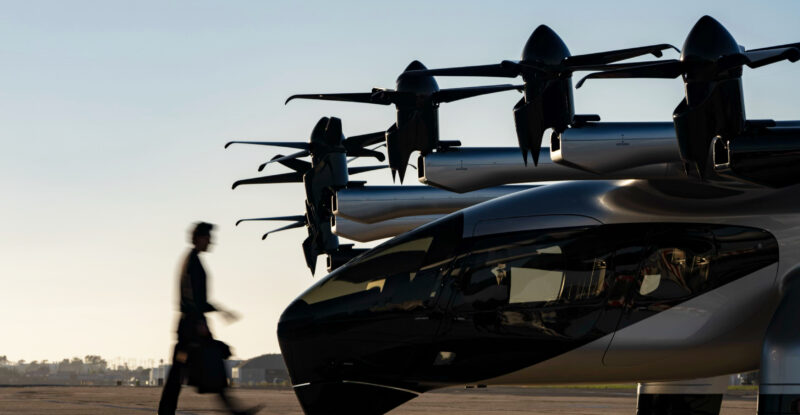
Archer is hoping its eVTOL aircraft, which features 12 electric motors and propellers and can carry up to four passengers plus a pilot, will be certified in time to operate air taxi services during the 2028 Olympic and Paralympic Games in Los Angeles. Goldstein said on the earnings call that he was hopeful California would be among the states picked for the eIPP alongside Florida and Texas, “given our plan to ramp operations ahead of the Olympics.” However, it later transpired that California had not been included in the initial pilot.
To reach its Olympic goal, Archer will not only need to achieve certification for its aircraft but also see the necessary infrastructure put in place. Additionally, it will need to win over public opinion about flying air taxis.
“Seeing new aircraft flying over major cities will be exciting at first, but we do need to get people comfortable with them and ultimately accept them as an everyday outcome,” Goldstein acknowledges. “That is how we’re going to drive consumer acceptance.” He wants the public to eventually see air taxis as “part of their everyday commute — just like Waymos.” Waymo is a driverless ride-hailing car service which mainly operates in the USA but plans to expand internationally.

Aside from air taxi services, Archer is “optimistic about winning a major defense contract this year,” says its founder, and sees software as a third application for its technology.
“We partnered with Palantir for next-generation air traffic control and route planning and we’re working with Nvidia to integrate their IGX Thor program into Midnight for safety-critical autonomous applications,” says Goldstein, adding that Archer is also “working with SpaceX’s Starlink to bring high-speed, low-latency connectivity to our aircraft.”
Archer ended 2025 with $2 billion in liquidity. The company’s full-year net loss widened to $618.2 million from $536.8 million a year earlier, which it attributes to a $219.9 million increase in operating expenses related to development, test, certification and production activities for its aircraft.
Related Articles:
- How Deutsche Aircraft is differentiating with its D328eco strategy
- ZeroAvia details headwinds that are slowing its certification timeline
- EVIO details plan to disrupt regional market with hybrid-electric aircraft
- Eve Air Mobility CCO Megha Bhatia on what sets its eVTOL apart
Featured image credited to Archer