

Lufthansa Group’s decision to tap SpaceX Starlink for its entire fleet after recently fitting European Aviation Network kit to narrowbodies and selecting Panasonic Avionics’ multi-orbit inflight connectivity for some A330s underscores a relatively new market paradigm: IFC contracts are getting shorter, and those with the heft and flexibility to do so, can turn on a dime.
Whereas Lufthansa Group once trumpeted both IFC products — calling EAN a “game-changer” in 2024 and Panasonic multi-orbit “a real upgrade for our guests” just nine months ago — it’s now staying quiet about the number of aircraft fitted with each system.
“The existing technology, including EAN will continue to be used on the respective aircraft until Starlink is implemented and will remain available to our guests until then,” a Lufthansa Group spokesman told RGN, just two months after he assured that the Group would finish equipping 150 narrowbodies with Viasat/Deutsche Telekom’s hybrid ATG/S-band EAN by the end of 2026.
It is surely the most rapid about-face this journalist has ever covered.
Viasat, meanwhile, is staying positive despite Lufthansa Group and IAG Group’s planned EAN defection, telling RGN: “The European Aviation Network was built for Europe, and we’re proud of the role it plays in connecting the continent’s skies. We will continue to provide world-class Wi-Fi to passengers on-board Lufthansa Group aircraft as well as our other EAN customers for some time to come, and EAN remains an important, enduring part of Viasat’s global aviation portfolio.”
Outside of Lufthansa Group and IAG, Aegean Airlines is an EAN customer (one that has unleashed its full potential.) And even as its customer base shrinks, Viasat and partner Deutsche Telekom are expanding the EAN to include Serbia.
Lufthansa Group’s network and value carriers are of course also long-time customers of both Panasonic and Viasat-formerly-Inmarsat’s GEO-based IFC solutions (some 15 years ago, I was on board Lufthansa’s launch of Panasonic Ku-band IFC on an A330, and uploaded a YouTube video in flight via the GEO connection.)
But what of leisure carrier Discover Airlines’ A330s; are any of the twinjets flying with Panasonic’s multi-orbit system right now? Seemingly intimating that there exists at least one or more fitted birds, the Lufthansa Group spokesman responded by both reiterating his prior statement that “existing technology” will remain in play until Starlink is implemented, and adding: “Unfortunately, we cannot share how many aircraft are currently equipped with which technology.” Panasonic declined to comment.
With a plan to roll out Starlink across its fleet starting in the second half of 2026 and complete the project in 2029, it would stand to reason that Lufthansa Group — which now describes itself as in the process of ‘evolving from a group of airlines into an integrated airline group’ — would first focus on bringing Starlink to disconnected birds, meaning that any aircraft carrying EAN and Panasonic multi-orbit would fly with the new hardware for at least a few more years. And it certainly sounds like that is Viasat’s expectation for EAN-equipped Airbus narrowbodies.
But even here, Lufthansa Group is staying mum. When asked if narrowbodies, widebodies or RJs will be first in line, the spokesman said: “The exact allocation [of Starlink] to airlines and fleets will be communicated in the course of 2026. The rollout plans are currently being developed.”
Further uses for Starlink on board, such as its possible integration with seatback IFE, are also “currently being developed.”
Interestingly, Lufthansa Group’s MRO behemoth, Lufthansa Technik last year revealed a modified TIOS-branded radome and structural integration unit which can mount at least one of two Starlink phased array antennas on an aircraft’s vertical stabilizer. And it said it would target airlines for the system. However, Lufthansa Group is not presently targeting any of the network, value or regional carriers within its own Group. “A TIOS installation is not planned as of now,” said the spokesman.

Also of note: Lufthansa’s Starlink announcement was made one day after the UK set the wheels in motion to revoke a 2010 regulation that authorized use of the 2 GHz MSS frequency band which is utilized by Viasat for EAN (and separately, EchoStar for IoT and mobile connectivity). Licenses will expire in May 2027.
Viasat’s license has not been revoked. The UK simply eliminated old EU rules which no longer apply after Brexit.
While the European Commission is presently deliberating on the future of the 2 GHz band, Lufthansa Group in September went to bat for the EAN, telling the EC it “is essential” that EAN can continue to access the band, and adding that EAN “is a critical building block in continuing to offer an industry-leading connectivity solution to our passengers. The EAN allows us to drive engagement with our customers, develop new revenue streams, improve flight planning, and make us more competitive.”
It went on to say that Lufthansa Group, “much like Viasat, Deutsche Telekom and others in the EAN value chain have collectively invested almost half a billion Euros into making the EAN a reality” for 150 Lufthansa Group aircraft.
Lufthansa Group said it chose the EAN because, among other reasons, EAN boasts an “ultra small size and low weight, it is optimised for European flights and delivers low latency and high bandwidth. Its size benefits result in lower costs, both one-off and lifetime, swifter installation, better environmental performance and better passenger experience.”
But a different song is now being sung.
Asked by RGN if the UK’s 2 GHz announcement impacted its fleet-wide Starlink decision, the spokesman said: “Lufthansa Group chose Starlink as the connectivity solution for our onboard product as they are currently offering the best connection quality worldwide.”
Related Articles:
- How Telesat plans to differentiate in LEO with Lightspeed
- IAG taps Starlink to power inflight Wi-Fi for 500-plus aircraft
- SES flags risk when airlines ‘hand over the keys’ to Starlink
- Lufthansa hands massive fleet-wide IFC contract to Starlink
- How Boeing Global Services is supporting Starlink installs on 787s
- EAN inflight connectivity astounds on Aegean A321neo
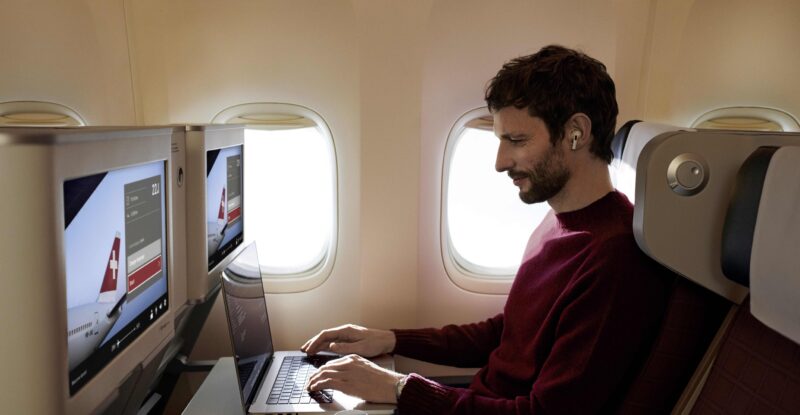
Featured image credited to Lufthansa Group member SWISS