

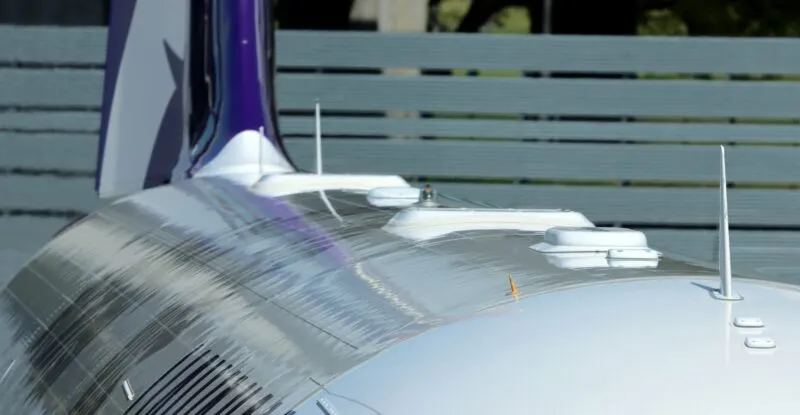

With a slew of top tier airline customers under its wing — including, as of this week, Lufthansa Group — SpaceX’s Starlink Low Earth Orbit (LEO) satellite-powered inflight connectivity has certainly proven to be a disruptor in aviation.
But is it risky for carriers to commit their entire fleets to Starlink, essentially putting all their eggs in one basket? What happens when it’s time to renegotiate short subscription-based service agreements? Won’t SpaceX be in the driver’s seat?
“There’s absolutely risk. I think they’re handing over the keys, frankly, to the future,” SES vice president of global airline partnerships Enrique Villasenor told RGN during an in-depth interview last month.
Larger airlines have traditionally taken a multi-source approach to IFC. But the game has changed with Starlink, as majors commit their entire fleets to the product, including Air France, Alaska Airlines, Emirates, IAG Group, Lufthansa Group, Qatar Airways, United Airlines and SAS, which has just taken flight with the first EASA certified Starlink-fitted A320.
“From what we hear, from what we understand, it is their whole pitch — it is all or nothing. It’s got to be the whole fleet,” said Villasenor, a former executive with Intelsat, Gogo and American Airlines.
It is perhaps also true that, if push came to shove, some major airlines might have the appetite for another quick-turn rip-and-replace program, given their large in-house MRO operations (after all, many of them have taken the lead on installing Starlink on their planes). In short, they have some leverage of their own.
“We saw it with Delta and us,” Villasenor said candidly of the SkyTeam member’s decision to replace the Gogo-Intelsat-now SES 2Ku solution with Viasat’s Ka-band system on a large portion of its fleet.
“There are certain big groups that could rip and replace if they fall apart with a vendor for whatever reason,” he said, noting that “part of the universe of airlines” that SpaceX is going after “are airlines that could do something like that.”
“But,” he added, “there’s not many that do that.”
That’s just one reason why, despite the momentum behind Starlink, there is still worthwhile IFC business to be won in commercial aviation in the here and now. A meaningful number of airlines are just starting to dip their toe into IFC, and prefer a partnership approach with their aero ISP. And some carriers are keen to avail of the redundancy and resiliency provided by multi-orbit IFC solutions.
Indeed, nine out of ten RFPs that Villasenor is seeing explicitly require multi-orbit IFC functionality, he said, which helps to insulate airlines in the event of a LEO network blackout or geostationary (GEO) satellite anomaly, and handily addresses geopolitical constraints around LEO, including for airlines that fly into and over China and Russia.
To meet this demand, including in Asia, SES is offering a cadre of options, including a multi-orbit Ku-band LEO/GEO electronically steerable antenna-based solution that uses a Gilat ESA to talk to its GEO satellites and Eutelsat OneWeb’s LEO constellation; plus a multi-orbit Ka-band MEO/GEO ‘Open Orbits’ solution that uses ThinKom’s Ka2517 VICTS antenna to talk to both its Ka GEO and mPOWER MEO assets (and which would technically be primed to accommodate Telesat’s Lightspeed LEO network in the future.)
SES is also advancing a plan to bolster its ‘Open Orbits’ offering, including with a next-generation architecture that will add multi-network, multi-beam, and multi-band (Ka/Ku) functionality.
That’s in line with the direction already taken by Hughes Network Systems, which is rolling out a hybrid system for Delta and other airlines that ticks all the “m” boxes, including multi-band, by pairing its own Ku-band LEO-only ESA for OneWeb service with ThinKom’s Ka-band Ka2517 VICTS in a single compact package.
The system has been shortlisted for a Crystal Cabin Award and installations are expected to begin soon.

For its part, Hughes Network Systems sees aviation as “a big market,” and the firm is “absolutely” confident it remains a growth engine, Reza Rasoulian, SVP & GM of the Hughes Aviation Business Unit told RGN.
“I think airlines want the optionality, they want the flexibility that Hughes has been providing and is able to provide,” he said.
“We have a lot of differentiation in what our offering is, and flexibility in our commercial models as well. We see a very lucrative market, as evidenced by our continued investments in people and processes.”
Related Articles:
- Lufthansa hands massive fleet-wide IFC contract to Starlink
- SES targets thousands of additional tails for IFC partnership model
- Qatar Airways becomes first in the world to bring Starlink to 787s
- Hughes positions newly acquired Anderson as hub for rapid prototyping
- Delta RJs near completion of Delta Sync free Wi-Fi equipage
- SES looks to bolster Open Orbits for airlines
- Avianca rolls out SES multi-orbit IFC on A320 Family twinjets
- China Southern picks SES as MSP for 50 A350s contracted for HBCplus
Featured image credited to Seth Miller