

Please enjoy this Op-Ed contribution from Unum VP Business Development, Alan McInnes
Moving beyond the traditional considerations of structure, comfort and certification, aircraft seating is a critical integration point for power, in-flight entertainment (IFE) and connectivity systems that passengers increasingly expect to function seamlessly.
As these systems become more central to the passenger experience, the challenge for seat manufacturers is not simply how to integrate them, but how to design seating architecture that accommodates them from the outset, without introducing unnecessary weight, complexity or maintenance burden.
For Unum, that challenge starts with a simple principle: begin with the passenger, then design the architecture around that experience.
Starting with the passenger, not the hardware
Electrical systems in aircraft seats are often treated as secondary additions to a seat structure that has already been defined. The result is familiar to frequent travellers, who encounter issues such as poorly positioned power outlets and awkwardly located screens.
The design process should actually begin by asking what the passenger needs and how that translates into physical interaction with the seat.
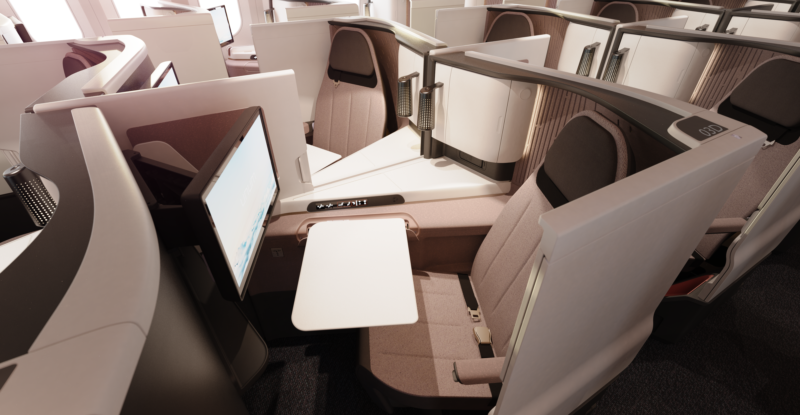
Screen positioning is a clear example. In Unum’s core architecture, the centreline of the IFE screen aligns with the centreline of the seat. This ensures that the passenger’s natural line of sight is respected, regardless of seating position. A dedicated monitor mechanism allows the screen to tilt, maintaining a comfortable viewing angle whether the passenger is seated upright, reclined in a Zero G position or lying flat.
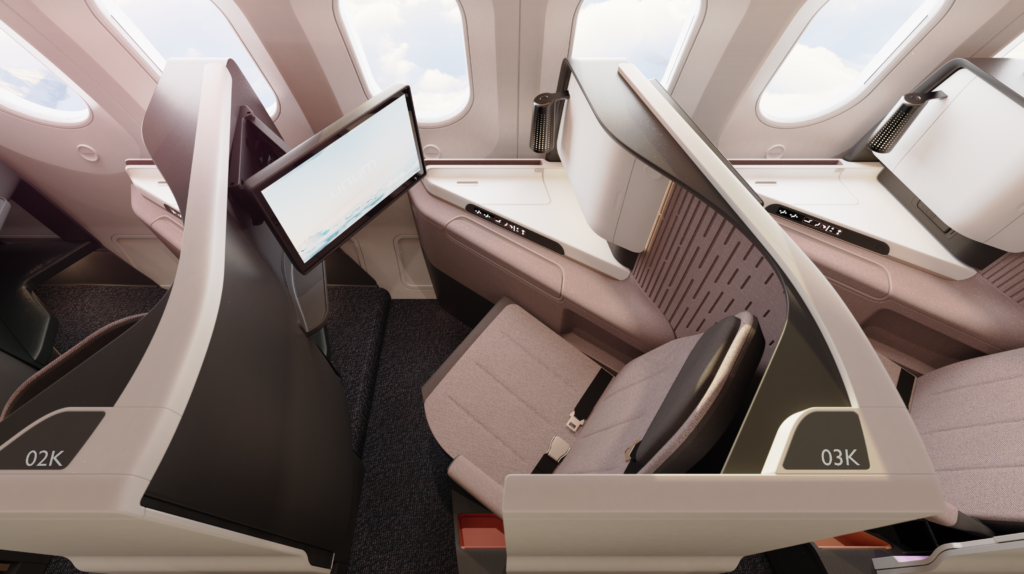
Power provision follows the same logic. Access points must be immediately visible and easy to reach and to use. Locating USB ports beside the shelf where passengers place their personal electronic devices, alongside a dedicated holder, removes guesswork and reflects how passengers actually use their devices during a flight.
These decisions may appear simple, but they are often lost when systems are introduced late in the design process.
Where weight and complexity creep in
The addition of power, IFE and connectivity systems can quickly introduce hidden penalties. Wiring runs become longer and more complex, structural elements are added to support hardware and maintenance access becomes more difficult.
Much of this stems from fragmentation in design thinking. When systems are developed in isolation and integrated later, each component brings its own requirements, often resulting in inefficient routing of cables and unnecessary parts.
Unum’s design philosophy addresses this by concentrating electrical complexity within a defined area of the seat. By doing so, wire runs are shortened and simplified, reducing both weight and build complexity. This approach also improves maintainability, as technicians can access key systems without dismantling large sections of the seat.
We’ve also created a monitor mechanism that allows the IFE screen to ‘float’. Rather than enclosing the screen within a heavy, fixed structure, the screen is mounted in a way that resembles a wall-mounted television in a home. This eliminates the need for additional supporting structure around the display.
This reduces weight by removing unnecessary material and creates a clearer upgrade path. As display technology evolves, airlines can replace screens more easily without requiring significant redesign or structural modification.
The cost of the bolt-on approach
In practical engineering terms, the difference between early-stage integration and a bolt-on approach is significant.
Economy class is a good example. I’ve flown in aircraft where the in-seat power supply (ISPS) units are retrofitted to the seat leg, behind the passenger’s legs. While technically functional, this location is neither intuitive nor convenient. Many passengers remain unaware that power is available, and those who do find it often struggle to use it comfortably. This is not a failure of the technology itself, but of how it has been integrated.
Bolt-on solutions can also increase weight, as additional elements are required to support new components. Certification becomes more complex, as modifications must be validated against an existing structure that was not designed to accommodate them.
In contrast, early integration allows these considerations to be addressed before constraints are introduced. The result is a more efficient and lighter design.
Designing for future evolution
The pace of change in IFE and connectivity systems presents another challenge. Screen sizes, resolutions, power requirements and connectivity standards continue to evolve, often on shorter cycles than seat certification programmes.
To remain viable over time, seating architecture must be designed with this evolution in mind.

One solution is creating defined ‘protected spaces’ within the seat for third-party hardware. These spaces are designed in collaboration with IFE providers, ensuring compatibility with current systems while allowing flexibility for future upgrades.
In tandem with this, thermal management should also be considered early in the design process. As electronic systems become more powerful, cooling requirements increase. Designing with these requirements in mind avoids the need for retrofitted solutions that can add weight and complexity later.
By aligning early with hardware providers, seat designers can anticipate future needs and avoid locking the architecture into a configuration that quickly becomes outdated.
A shift in mindset
IFE systems mustn’t be treated as an afterthought and should evolve with seating architecture to ensure they stay aligned with the passenger’s expectations.
This requires a shift in mindset, from viewing seats as static structures to understanding them as dynamic platforms that support a connected passenger experience.
For manufacturers, the challenge is to deliver this capability without increasing weight or complexity. For airlines, the opportunity is to offer a more intuitive and reliable experience that aligns with how passengers use technology in everyday life.
The answer lies in starting with the passenger, simplifying integration and designing with future technology in mind. And in an environment where every kilogram matters and every interaction shapes perception of an airline, getting that balance right is no small task, but it is essential.
 About the Author
As VP Business Development, Alan McInnes leads business development and sales for Unum, fuelling his passion for building new relationships.
Over the early stages of his career, Alan held the role of head of inflight services for several airlines including Thomas Cook, while also working in operational and commercial roles for cabin supply companies covering inflight services, retail and entertainment.
Prior to joining Unum, Alan worked as VP Business Development at Caeli Nova, implementing the necessary processes and procedures to support a recruited team as the business went to market for the first time. Prior to this Alan was SVP Sales at Acro Aircraft Seating where his team secured several major achievements, managing to double the company’s sales revenue in a three year period, in addition to securing Acro’s first customers in Asia Pacific, China, South America and the Middle East. Alan is goal driven and experienced in establishing new market opportunities.
Related Articles:
- Panasonic enjoys rapid IFE growth as connected seatback takes wing
- Connected seatback at the fore as RAVE Aerospace enters new era
- Op-Ed: The legacy IFE debate — remove, replace or reinvent?
- Op-Ed: Five key trends shaping the future of travel
- Unum launches Unum One herringbone on TAAG 787 and Wamos A330
All images credited to Unum