

When Viasat brings its high-capacity Ka-band ViaSat-3 F2 satellite on line for the Americas in the near-term, and satellite launches commence for Telesat’s Lightspeed LEO network — which Viasat will tap into for its Amara multi-orbit inflight connectivity service — the Carlsbad, California-based firm will be primed to reengage some of the airline customers that have defected to SpaceX’s competing Starlink IFC service.
When those things come together, “I think it really sets the stage for that next discussion,” Viasat’s vice president of global aviation partners and service delivery, Brian Simone said in an IFC conference session moderated by your author at APEX TECH in Los Angeles. Telesat vice president, aviation Philippe Schleret and ThinKom Solutions chairman and CTO Bill Milroy also served as panelists.
Ready for another cycle
Like other prominent aero ISPs, including Panasonic Avionics and SES, Viasat has seen several airline customers pivot to Starlink, even as it continues to win new IFC awards. But market dynamics are changing. For one, some IFC contracts are getting shorter, meaning that Viasat could find itself back at the negotiating table with these same airlines in the not-too-distant future.
Said Simone:
So, it might be ‘hey, we found out that Starlink might have congestion issues in certain areas, and that might not be tenable,’ or ‘boy, that cost-benefit ratio isn’t quite right for me.’ And so, absolutely, we’re there for the airlines. We think that we’ll be positioned well when that cycle comes back around, and in the meantime, we’re going to continue winning there.
Some inflight entertainment and connectivity stakeholders anticipate that Starlink will face beam congestion on busy flight corridors. For Simone, the combination of LEO and GEO, as supported by Viasat’s Amara platform, will position it to “have the highest likelihood” to address any congestion that Viasat may encounter on those same corridors.
If we have a high demand in one asset, we could switch to the other. So we’re looking at what those SLAs should look like when you’re in this multi-orbit environment, and how to ensure that we’re delivering that best experience. Focus on the passenger experience, deliver that passenger experience, and set the metrics to demonstrate that we’re able to do that.
New IFC awards
In terms of winning new business, Viasat continues to see tremendous opportunities in the market, despite the success of Starlink.
“You know, as we look around the globe, we’re continuing to win airlines. We’re getting additional fleets with our current customers, and so, yes, it’s competitive,” Simone said.
But it’s also “a big market. There’s a lot of aircraft coming out. Airbus and Boeing have backlogs that they can’t produce aircraft fast enough.” And while Viasat has long been a proponent of the full, fast, free Wi-Fi model, having set the standard at JetBlue, it is willing to work with carriers that aren’t yet ready to go in that direction.
“Not everyone is going to be able to afford a full, free offering. So, what are the products that help offset that? Monetization, ad platform, some of those things that we offer to our customers will help ensure that they can get connected,” Simone said.
There are also “plenty of airlines who want the dual-source approach” to IFC and don’t want to be locked into any single provider, he noted. “And that’s okay. You know, we’re here for you. We have the right products, and the market is big, so we’re not afraid of what that looks like.”
Passengers using Viasat over ViaSat-3 F1 think they’re on Starlink
In the lead up to the launch of Viasat’s first ViaSat-3 satellite, the F1 asset for the Americas, there was a tremendous amount of excitement in the market, including for what it would mean for the airline passenger experience. But F1 experienced an anomaly, reducing throughput to an estimated 5% to 10%.
That anomaly could be seen as having created a crack in the armor — an opportunity for Starlink and indeed Amazon LEO to slide in, as the latter has done at JetBlue.
But now that ViaSat-3 F2 has successfully launched and is presently making its way to its orbital slot, excitement is starting to build again among Viasat’s customers in the US and aboard, as many of the latter serve the Americas. “Once it gets to orbit, we have to deploy the reflectors and do all the testing and all the things that we need to do to bring that on line,” Simone noted.
Part of the excitement around F2 is based on the fact that Viasat has seen great results with the throughput it has been able to glean from F1. Focusing on aviation — specifically US-Hawaii routes — the firm has been able to effectively demonstrate the capabilities of F2 with the F1 bird. “[W]e’ve been able to use the western US to Hawaii as a proving ground.”
In doing so, Viasat has learned some very valuable things, including the fact that the technology works. That means all customers of Viasat’s current GM-40 gimbaled antenna “are going to be ready to go as soon as F2 comes online,” Simone said. “So, from a time-to-market standpoint, we’re almost there. That’s great.”
Viasat has also been able to leverage the GEO asset to provide what Simone describes as a “really, really good experience.”
We ran some tests. We had some double-blind studies, where folks flew different providers and got interviewed, and the result of that was almost no one could tell the difference between a Starlink flight and a Viasat flight.
He shared a story about a passenger who was triple screening on a flight from Los Angeles to Hawaii. Putting the service through its paces on his laptop, iPad and phone, the passenger confided that everything worked perfectly; he was able to work, stream, and do all the stuff he wanted to do, and he assumed he was aboard a Starlink-fitted aircraft. But it was Viasat “and so from an end user standpoint, the quality of service that’s coming out of that asset is really good,” Simone said.
The firm is “looking really forward to being able to leverage F2 and soon after [ViaSat-3] F3 in Asia-Pacific.” The latter will plug a gap in a key region, ensuring that major customer Delta, for instance, will be able to support its Delta Sync free Wi-Fi program on transpacific routes.
At present, F3 “is undergoing final integration and is anticipated to launch on a Falcon Heavy shortly after VS-3 F2 final deployments are complete, pending a specific launch date from SpaceX, with estimated service entry by late summer,” Viasat management stated in a 5 February shareholder letter released in tandem with the firm’s Q3 FY26 earnings.
Why multi-orbit?
But even as it bolsters its high-capacity Ka-band IFC proposition with F2 and F3, Viasat is gearing up to support multi-orbit IFC using its GEO assets and Telesat’s Lightspeed LEO service to enhance resiliency, to route traffic intelligently over the most efficient pipe (latency-sensitive over LEO) and to ensure it can operate around the globe including over the poles and over China, which has strict regulatory conditions.
“[H]aving the combination of a GEO asset and a LEO asset gives you the ability to have the best performance. So now we can leverage both things,” Simon said.

The Amara-branded offering will be supported by Viasat’s GM-40 gimbaled antenna, which is installed on thousands of aircraft in the world fleet. It will also run over Viasat’s in-development dual-beam electronically steerable antenna, dubbed AERA.
Though the IFC market is “competitive, no doubt about it,” Simone said, “we feel like we’re bringing the right technologies to market. The Amara story, the AERA antenna, the working together with Telesat to bring their constellation online.
“There’s many different dimensions of value that matter to the different airlines. It could be something like monetization and the digital product portfolio; that’s an important offering that ViaSat has available to us. So, we work together with our airline customers and look at what do they want to deliver. How do we make sure that our products are helping them to deliver their vision? That worked really well with Delta, like they’ve done phenomenal in the marketplace with all their connected aircraft.”
Related Articles:
- How Telesat plans to differentiate in LEO with Lightspeed
- Lufthansa Group to retain current IFC until Starlink pivot is complete
- KLM offers Viasat-powered free Wi-Fi on European flights
- American begins phased rollout of free Wi-Fi, including for new 787s
- IAG taps Starlink to power inflight Wi-Fi for 500-plus aircraft
- SES flags risk when airlines ‘hand over the keys’ to Starlink
- Press Release: Viasat to supercharge JetXP BizAv IFC with multi-orbit
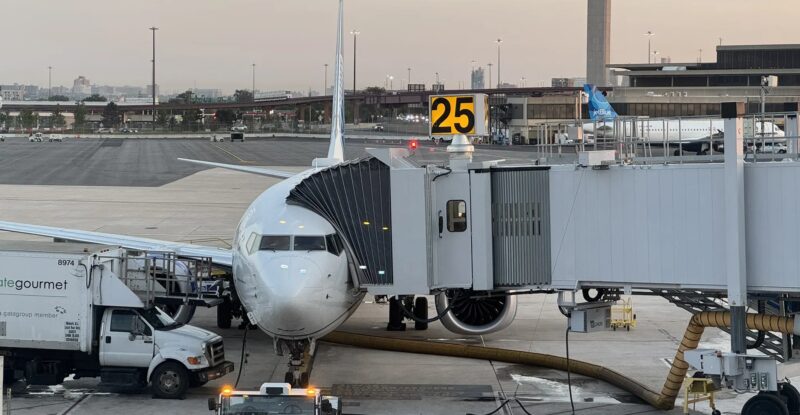
Featured image credited to Jason Rabinowitz