
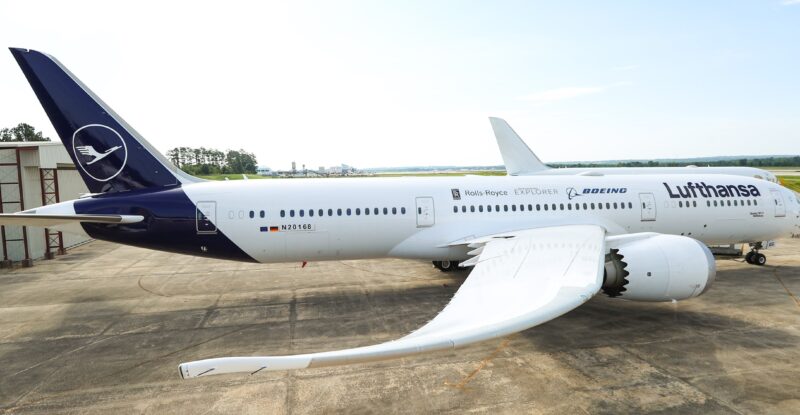

 A new Boeing 787 Dreamliner that is slated to be delivered to Lufthansa will first serve as Boeing’s newest ecoDemonstrator to flight test innovations that could improve fuel efficiency and reduce noise emissions.
Powered by Rolls-Royce Trent 1000 engines, the 787-9 this month will begin testing a new reduced-length engine inlet with advanced acoustic treatments, in addition to new departure and arrival procedures.
The next-generation inlet “enables the integration of more fuel-efficient engines onto future platforms, and reduces weight and drag while maintaining the acoustic performance,” Boeing explains. Rolls-Royce provided engineering support and oversight for operating the modified Trent 1000 with the new inlet installed.
Also being explored are ‘Intelligent Operations’ flight paths, which are algorithmically generated using multiple data sources. These new procedures aim to curtail community noise around airports and identify opportunities for improving fuel efficiency.
The technologies being tested are part of Phase III of the U.S. Federal Aviation Administration’s CLEEN (Continuous Lower Energy, Emissions and Noise) program, a public-private partnership that sees government and aviation companies split the cost of researching and developing new green wing solutions.
“Once testing is complete, the aircraft will be returned to its original configuration and delivered to Lufthansa at a later date — joining our highly-efficient Dreamliner fleet,” Lufthansa Airlines CEO Jens Ritter says in a statement published on LinkedIn.
“But what stays is the knowledge. The transformation of aviation succeeds only collectively — with manufacturers, engine developers, and airlines working in genuine partnership. This is what that looks like in practice.”

First established in 2012, the ecoDemonstrator program advances the exploration of technologies that can help make aviation more efficient and sustainable. Through the years, Boeing has partnered with various airlines, including but not limited to Alaska Airlines, Etihad Airways, FedEx and United Airlines, and has evaluated more than 260 technologies, including sustainable cabin interiors.
Their work has been quite meaningful. In 2023, for example, sustainable aviation fuel (SAF) used in the ecoDemonstrator flight-test program was found to produce “dramatically” reduced soot particles and contrails.
“Lufthansa Group and Boeing share a long-standing partnership in aviation. We are pleased to support this year’s Boeing ecoDemonstrator Explorer program alongside Rolls-Royce,” says Lufthansa Group chief technology officer Grazia Vittadini of the carrier’s ecoDemonstrator collaboration with Boeing.
Testing begins later this month at the Boeing site in Glasgow, Montana, and is expected to run through mid-August.
Related Articles: