


MIRABEL, Québec — Airbus has sped up its studies of a stretched version of the A220 and is in the process of internally evaluating what it would take to bring it to life. The range, maximum takeoff weight (MTOW) and powerplant are among the parameters being earnestly assessed, as is the amount of production facility investment required for the aircraft, which is widely expected to be named the A220-500.
“We’ve been working very hard, and we have accelerated the studies on the stretch. It’s no secret that we have been looking at the potential stretch, but this year there has been a particular focus on it,” Airbus Canada Limited Partnership CEO and head of the A220 program Guillaume Chevasson said during a media briefing at the A220 final assembly line (FAL) plant in Mirabel, Québec.
The airframer could decide this year about whether or not to press ahead with a formal program launch, he said, but it has already made one important conclusion about the passenger experience: if it moves forward with the stretch, it will not change the A220’s unique and highly comfortable 2-3 configuration that has become such a big hit with passengers.
“We will not change the five-abreast,” Chevasson assured when asked by RGN if the airframer would densify a stretched A220 beyond five-abreast.
The ability to accommodate spacious 18.5”-wide seats in a 2-3 layout is a key selling point for the current A220 variants, the -100 and -300. “Travelers love flying the A220,” Christian Kley, Airbus head of single-aisle market development enthused of the aircraft, which is being used by airlines to upgauge from regional jets and replace previous-generation single-aisle aircraft while opening new markets and increasing profitability.
The A220 consistently has the highest Net Promoter Scores within an airline’s fleet, Kley said.
Operators have clearly taken notice, with Airbus recently surpassing the 1,000-firm order milestone for the A220 family after AirAsia placed an order for 150 A220-300s. The AirAsia aircraft will feature a new high-density, 160-seat configuration, which is the scope of what can be accomplished aboard the -300 by adding a set of overwing exits and tightening seat pitch, possibly to 28 inches but “below 30 inches for sure,” Kley said.
Notably, this A220-300 densification effort for AirAsia — and indeed any other carriers interested in the same — will not happen by squeezing another seat into the width of the cross-section, but rather by adding roughly five rows of seats.
Airbus’ revelation that it will provide a densified version of the A220-300 has not quelled interest about a prospective A220-500, even though there are continued questions about whether the latter might encroach on the A220’s massively successful big sister, the A320 family. After all, the A220 interior now even shares the design language of the A320, with Airbus’ popular Airspace cabin including XL flip-up bins set to debut on a new Air Canada A220 in the not too distant future (once the cutover is made, Airbus will no longer install pivot bins on the A220.)
The chatter around a stretch version has only grown louder since early May when AirAsia chief Tony Fernandes, in announcing AirAsia’s order, expressed hope that Airbus will build “the A220-500, which is 185 seats” and vowed that if it does so, “AirAsia will buy another 150 of these aircraft as well.”
Now, as industry prepares to descend on the Farnborough International Airshow on 20-24 July, there is intense interest in Airbus’ headspace on the matter. “We still have some work to do,” Chevasson said, whilst acknowledging that “our customers are calling for it.”
Of note, airlines are “looking for something simple” that iterates on the current family, and for the stretch to “come to market as quickly as possible.”
A stretch would impact weight which in turn would impact range. And so, before it presses the proverbial button, Airbus wants to “make sure that the impact on the range is well understood,” he noted.
Airbus is also in discussions with the A220’s PW1500G geared turbofan engine-maker Pratt & Whitney “to make sure that we have a right solution. So, we’re not there yet,” Chevasson said.

Reliability issues which have beset the GTF have largely been resolved for the A220, with Airbus expecting that, by the end of the year, there will be “zero” aircraft on ground (AOG) due to engine spares not being available.
Moreover, the improvements implemented by Pratt mean that any aircraft delivered from 2027 and onward will be at the benchmark for operational reliability, with a five- to six-year time on wing for the engines.
“We have come a long way with Pratt. I mean, today the relationship with Pratt is at a very good level,” Chevasson said, adding that with AOG nearing zero and the engine now close to benchmark “we have no reason, especially when we look at a simple stretch approach, to move away.”
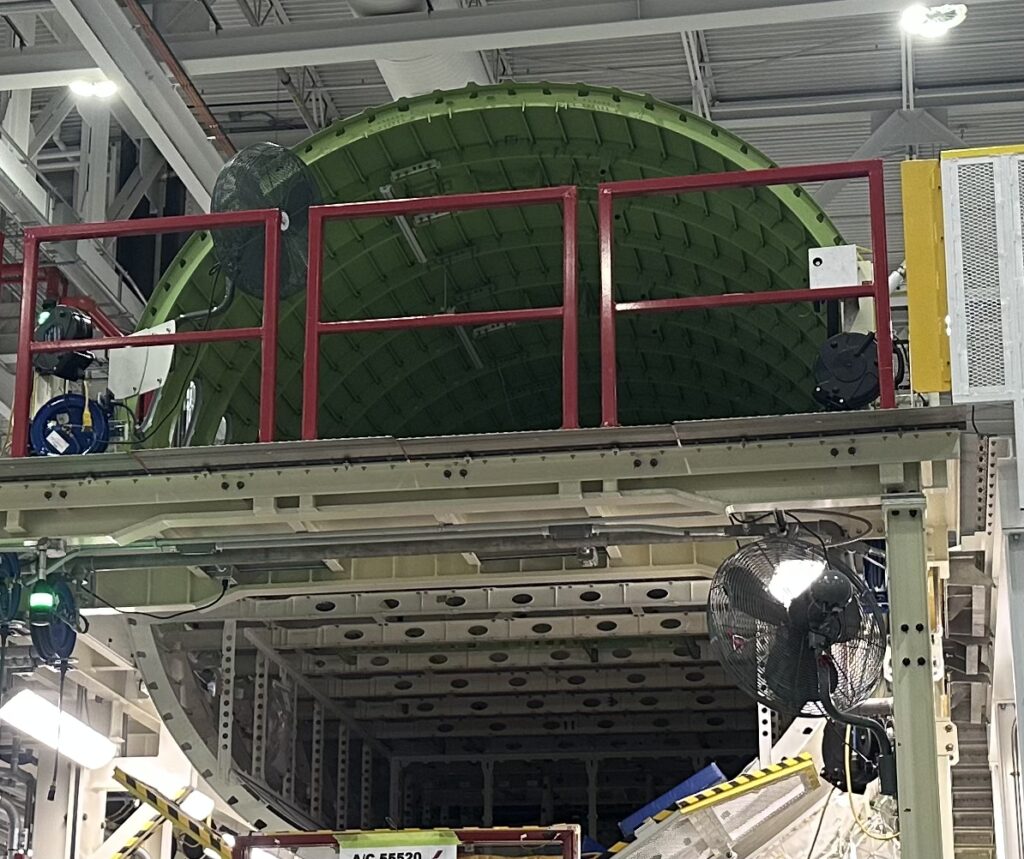
Though he stressed that the stretch is not yet an option, Airbus is studying the level of investment required to make it a reality, including around whether it will demand a new building or a new station on the Mirabel FAL. This decision will be influenced by the extent to which the aerostructures will be modified or not.
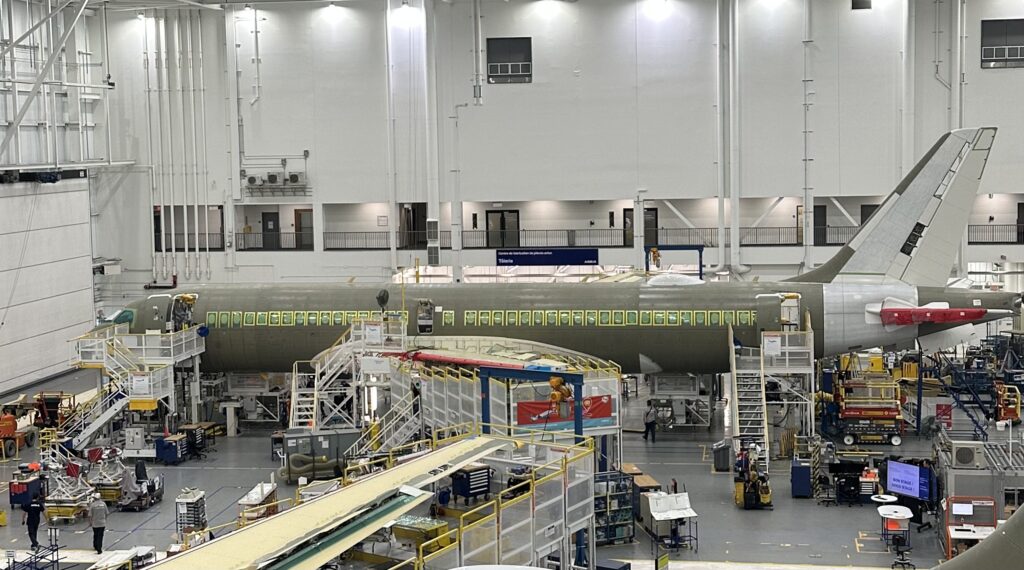
Airbus delivered 93 A220s in 2025. It is ramping up production to accommodate a rate of 13 per month by 2028, but the plant, in its current state, could handle 14/month.
RGN was a guest of Airbus in Mirabel.
Related Articles:
- AirAsia CEO to Airbus: build it and we’ll also buy 150 A220-500s
- Smartwings surprises with weird yet wonderful A220 service
- Airbus comes full C Series circle with Airspace A220 cabin, bins
- Croatia Airlines embraces Wi-Fi and USB in move to all-A220 fleet
- Airbus sounds the death knell for pivot bins on its single-aisle jets