

WASHINGTON D.C. — Rapidly putting the wheels in motion to launch a next-generation Medium Earth Orbit satellite network, dubbed meoSphere, SES intends to pair the new service with Low Earth Orbit satcom to power multi-orbit MEO/LEO inflight connectivity for airlines, company CEO Adel Al-Saleh revealed at SATShow 2026. The move will differentiate SES from other broadband IFC providers.
At present, the Luxembourg-based satellite operator and aero ISP provides two key multi-orbit IFC solutions in the commercial aviation market: a Ku-band electronically steerable antenna (ESA)-based system powered by its geostationary (GEO) satellite network and Eutelsat OneWeb’s LEO service, for which it is a distribution partner in aero; and a Ka-band ‘Open Orbits’ offering which combines low-latency, high-speed service from its current-gen O3b mPOWER MEO network with the stability and global coverage of GEO.
But when meoSphere is in operation, estimated in 2030, SES will help airlines graduate to a next-gen MEO/LEO-supported IFC solution, whilst meeting the needs of other commercial and defense missions including those of sovereign customers.
“Today we have 3,000 tails in aero [and] growing. Almost 1,000 of them are moving to a LEO/GEO capability and we see the direction of travel that the customer experience in the plane need — low latency and big bandwidth. Our direction of travel is to make sure that that solution becomes LEO/MEO,” Al-Saleh said in response to a question posed by Runway Girl Network during a media huddle at SATShow.
He continued:
So, as we move into meoSphere, the GEO will be replaced with a MEO capability, especially with what we’re launching. The new antennas will be able to do that. And that’s the opportunity. And all the airlines are extremely excited about that prospect.
Whereas O3b mPOWER was designed for backhaul, meoSphere is a very different design, taking MEO throughput capability to flat panel architectures, “which is what a lot of our customers are asking for,” Al-Saleh noted.
According to SES, standard 50 × 50 cm and 25 × 25 cm ESAs will be available for governmental, mobility, and fixed data applications, and will support speeds of up to 1 Gbps.
SES is already studying multi-band Ku- and Ka-band bridging technology, which would enable it to effectively pre-wire its airline customers for meoSphere, RGN can confirm.
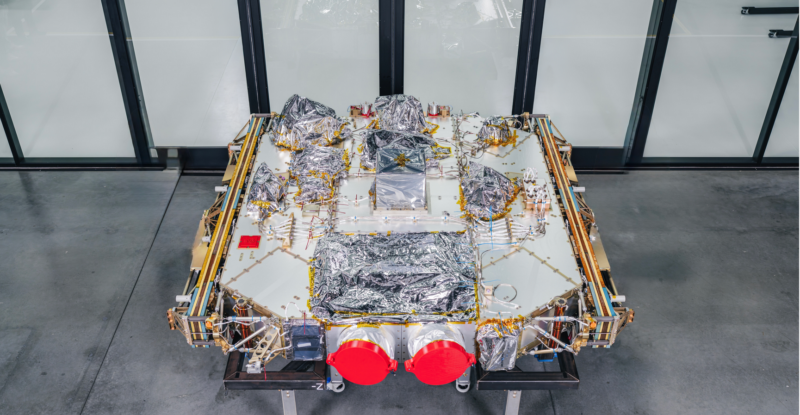
The company first started teasing details about the meoSphere constellation at last year’s World Space Business Week in Paris, as first reported by Via Satellite. Confirming a concrete plan to deploy meoSphere at SATShow in D.C., SES announced it has tapped agile California-based start-up K2 Space to develop an initial 28 high-power satellite platforms for the first phase of the meoSphere rollout.
The arrangement sees SES pairing its own software-defined payloads, as developed and manufactured in Luxembourg, with the initial batch of 28 satellites.
Work is already afoot. Indeed, on 30 March, K2 intends to launch the first of a series of MEO “pathfinder” missions which will be used to test and validate the satellite bus and SES payload components in orbit, as well as to refine operational concepts, and reduce risk ahead of full-scale deployment.
“We have our first pathfinder in six days that’s launching, and subsequent pathfinders next year and the following year before constellation rollout,” K2 Space co-founder and CEO Karan Kunjur confirmed to journalists during the 24 March media scrum. “The whole goal of the pathfinders is to start derisking the constellation, starting with this first mission in six days.”

Scaling of the network will be determined by market demand, SES said. But with 28 new MEO satellites, “this effectively doubles” MEO capacity beyond SES’s current MEO capacity, Kunjur said of meoSphere when queried by Satellite Mobility World about the aero-specific opportunities of meoSphere. “So obviously you can think about what the impact will be on the potential capacity it could sell for the aviation business.”
The K2 CEO added: “We’re going to fly ten of this exact same satellite over the next 21 months, all before the constellation rollout. So, the whole goal is rapidly iterate to get a lot of data on the performance of these systems so that they’re fully derisked before rollout.”
Notably, the new SES-K2 collaboration gives SES tighter control over key supply-chain elements, compresses the build timeline, and allows the company to manage schedules and costs with precision, laying the foundation for future scalability. That’s especially important to SES, as Al-Saleh explained:
We value all the history we have with all these partners that we’ve built. And Boeing is a great partner. They built one of the most advanced MEO capabilities [for mPOWER]. Thales, Airbus, Northrop Grumman, Lockheed Martin, they’ve all been incredible partners. But where we’re struggling is the speed of innovation and the cost of that innovation, and the signal this sends to the market is that everybody needs to evolve.
Everybody needs to change. We need to change the way we develop. We need to change the speed of our innovation. And we really need to think about the cost equation, because we cannot afford in our business cases to have satellites with three-digit-million-plus cost. We need them well into the double-digit-million cost. So we need to do something different, and that’s the message that the industry is getting.
Given that each meoSphere satellite will deliver 20 kW of power, the network will take satellite power “to the next level,” Al-Saleh told journalists. “We will have onboard processing. We’ll have digital beamforming capability. We’ll have the next generation of ASICs. This will be an ASIC that will be in its fourth generation, taking it to the next level. So yeah, it will be much more advanced than what we have currently on mPOWER.”
It will also feature optical inter-satellite links, and will seamlessly integrate with terrestrial mobile networks and other non-terrestrial network (NTN) systems.
SES’s work to support the EU’s IRIS² satellite constellation through the SpaceRISE consortium is separate from meoSphere, though Al-Saleh said “a lot of the components are reusable for IRIS².”
SpaceX’s Ku-band Starlink LEO-powered IFC service has obviously proven to be a disruptor in aviation, and it now boasts a laundry list of full-fleet deals including with Air France, IAG Group, Lufthansa Group, SAS, United Airlines and Virgin Atlantic. United has even signaled its intent to bring Starlink to its new 41-seat CRJ-450s.
But Al-Saleh continues to see tremendous opportunities in the market. “Aero is exciting and although the news you’ll see that Starlink is gaining incredible traction is absolutely true…the demand is so big,” he enthused during the Opening General Session at SATShow.
Related Articles:
- SES flags risk when airlines ‘hand over keys’ to Starlink
- Eutelsat reports ‘strong progress’ in IFC as LEO revenues take off
- Telesat further optimizes Lightspeed for defense, sees schedule slip
- SES targets thousands of additional tails for IFC partnership model
- Avianca rolls out SES multi-orbit IFC on A320 Family twinjets
- China Southern picks SES as MSP for 50 A350s contracted for HBCplus
- Air Canada extols virtues of SES multi-orbit IFC, nears E175 installs
Featured image credited to K2 Space