

Today, only about 8% of Panasonic Avionics’ embedded inflight entertainment systems in the world fleet are connected to onboard connectivity.
But in the not-too-distant future, Panasonic seatback screens will increasingly be “connected to the network,” including via low-latency Low Earth Orbit (LEO) satcom, and with that “we can do all sorts of interesting stuff,” Panasonic Avionics vice president of product & portfolio management Andrew Masson assured during a wide-ranging interview with Runway Girl Network.
A United case study
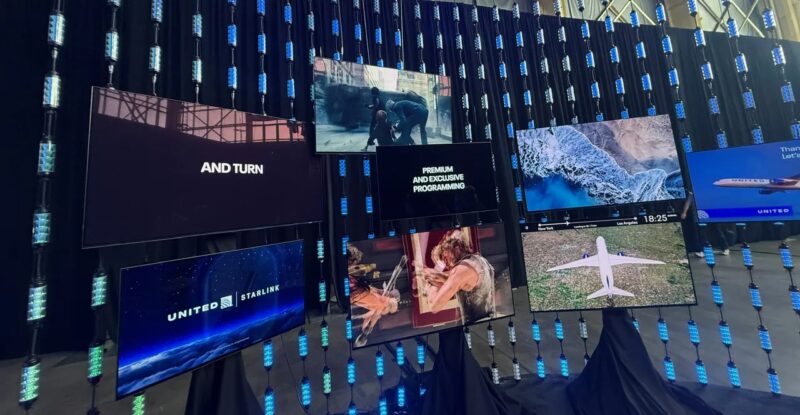
Among the carriers leading the charge — and demonstrating the art of the possible — is United Airlines, a prominent Panasonic IFE customer which is installing SpaceX’s Starlink inflight connectivity across its entire fleet and using the LEO service to, among other things, personalize the seatback experience.
Initially, this IFE/IFC integration will enable passengers to use their own devices to log in to the Spotify app on the IFE screen and enjoy their favorite Spotify content on the seatback — it will even facilitate their ability to pick up where they left off.
Ultimately, however, the sky is very nearly the limit as to what United can achieve with its Starlink-connected seatbacks.
“They are doing incredible things,” says Masson of United, “and they’re starting to lead this industry in digital engagement, and if people aren’t watching, then they’re nuts, because that’s an airline that’s on top of its game. And you’re starting to see a reaction from others because of it.”
He continues,
And you know, there’s other airlines out there that have a much nicer UX, but don’t have the digital engagement. When those two things come together, you’re going to have this tremendous experience on board. I mean, tremendous.
I’m kind of privileged. I get to see all these different things that the airlines are doing, and some of them have this gorgeous experience, like, unbelievable, but it needs some of the application stuff like what United are doing.
Still one of the largest inflight connectivity providers in the industry with its Ku-band geostationary (GEO) satcom solution, which is installed, for now, on United’s Boeing 787s and select Airbus A319s, Panasonic has admittedly seen a large share of airline customers signal their intent to migrate to Starlink for IFC.
But in a somewhat ironic twist, even as its IFC footprint has diminished, Panasonic’s seatback IFE business has never been busier, with its modular, next-gen, OLED-based Astrova system seeing the fastest adoption rate for any IFE solution ever introduced by the firm.
“It is our most successful platform. I think today we just went over 40 customers and have over 100-and-something programs. It’s like absolutely flying off the shelves, which is great,” Masson says of Astrova.
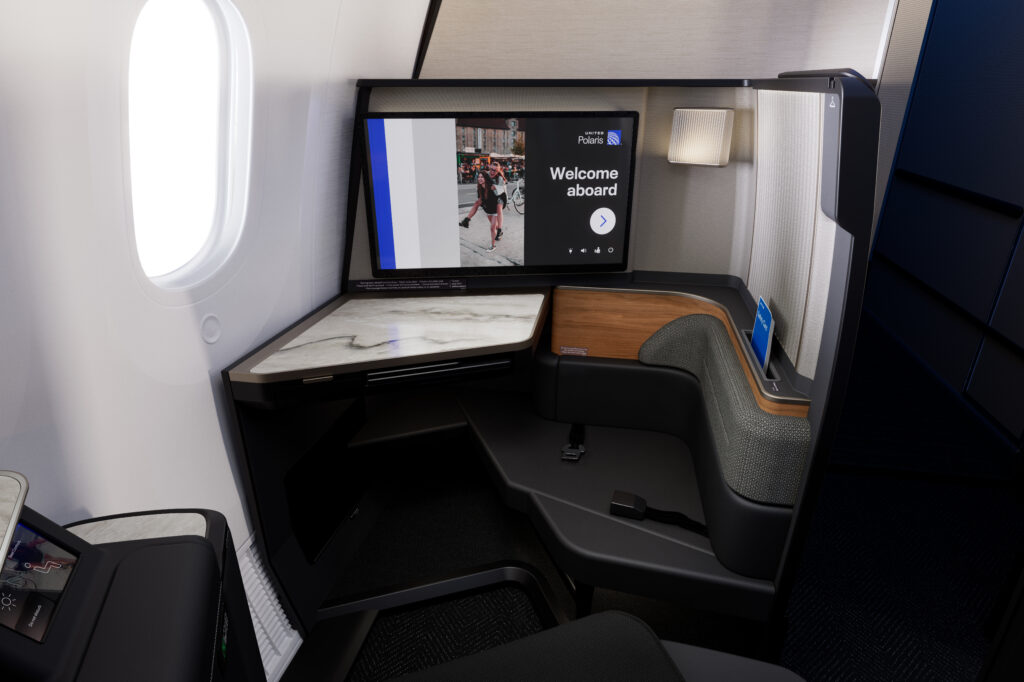
To wit, United in 2023 became the first Astrova customer in the Americas. And in less than ten days, on 24 March, the US major will formally unveil its new Elevated interiors for the Boeing 787-9, inclusive of doored Polaris suites up front and Astrova 4K IFE with Bluetooth connectivity from nose to tail.
With an IFE screen sized at 27 inches, United will offer the largest seatback display in America in its new business-plus Polaris Studio suites for the 787-9. The twinjet, like the rest of United’s fleet, is earmarked for Starlink equipage.
There are several reasons why Astrova is enjoying such a strong growth trajectory, and it’s not just because the connectivity-native IFE system can easily facilitate integrations with passengers’ personal subscription services and content such as Apple Music, Spotify, Netflix, Disney+, YouTube, and HBO Max — when requisite licensing agreements are brokered by the airline.
Astrova’s draw
There’s also the design, notes Masson. “It looks nice. It’s got all the technology in there with the OLED and the Bluetooth.” Moreover, he says, “the sustainability element of Astrova is twofold. One is it is very light and the technology has enabled that. OLED doesn’t just look tremendous, but it’s also a much lighter weight platform, and it enables us to make the screen thin and make the design look beautiful.”
He adds:
But the sustainability is not just borne from being lightweight; it’s also the fact that I can update the microprocessor, the memory, the Bluetooth, all the little USB connectors and stuff, without having to change the whole system. And you know, it’s what the airlines have been asking for, for so long.
They buy an airplane. They get it after five years. The backlog for aircraft is huge, especially if you want a narrowbody. There’s only two OEMs, and they’re working as best they can, but they produce, you know 100 aircraft per month in total. There’s more demand than capability to build airplanes. So, airlines get their aircraft and, by the time it enters revenue service, the IFE platform they bought with the aircraft might be six years old. And then it has to last 20 years. And that was the emphasis when we asked ourselves, ‘how do we get something and make it HIC friendly to begin with?’ OLED does that, and then if they need to update it, allow that to happen.
Asked by RGN if the march of Starlink in commercial aviation has benefited Panasonic from an embedded IFE front, Masson says: “Oh my gosh, yes, the connected seatback is brilliant. We’ve partnered with them on several programs. It’s working really well. It really helps us out.”
Indeed, for Panasonic, the connected IFE applications that Starlink can support via Astrova and other Panasonic IFE platforms, and the excitement they are creating “is more than making up for” any reduced IFC business and “it’s tremendous,” he says.

The Panasonic Avionics executive believes LEO-powered IFC is “100% better” than prior-gen IFC solutions, with the service’s low latency having “the biggest impact.”
Meanwhile, the Irvine, California-based firm has adopted an agnostic approach to IFC, similar to how it serves the aviation market with its Arc moving map.
“What we need is fast connectivity on the airplane. And, you know, we have a solution, but we’re agnostic, really. I mean, we have a map solution, but you can buy maps from somewhere else,” Masson says. “Ours is just the best.”
Related Articles:
- United looks to set long-haul premium standard with Elevated 787-9
- Panasonic Avionics sees Astrova Curve debuting in first class
- How United is leveraging Starlnk and the cloud to enhance IFE
- Why FlightPath3D stays ahead of geopolitics for aviation
- Connected seatback at the fore as RAVE Aerospace enters new era
- Icelandair A321LR features several firsts including Astrova IFE debut
- Panasonic enhances Arc 3D moving map platform
- United and Delta tout NPS and wellbeing benefits of seatback IFE
- How Delta Sync seatback demonstrably improves PaxEx
- Thales talks event-based 360Stream and near-live highlights
Featured image credited to Chris Sloan. Embedded image credited to United Airlines