

The inflight connectivity marketplace is moving very quickly. And aviation industry stakeholders have never seen anything like it before. The cycles are getting faster. The technology is evolving rapidly, including the antenna hardware. At least five or more broadband Low Earth Orbit (LEO) satellite constellations are expected to be in orbit by the end of 2027 (there are already two: Starlink and Eutelsat OneWeb, with Amazon LEO, Telesat Lightspeed, China’s Spacesail and others in the offing). And the connected seatback is on the horizon.
Given these circumstances, and the vast number of IFC pipes and configurations available to aircraft operators — including hybrid LEO/GEO, LEO-MEO-GEO, and ultimately LEO-LEO options — there is an opportunity for airlines to rethink who controls the cabin connectivity layer, putting themselves in the driver’s seat.
That’s the message that Quvia is sharing with airlines now that it has helped the cruise industry and other verticals reshape how they do business using its AI-powered ‘Grid’ platform to deliver real-time visibility into network performance and Quality of Experience (QoE), while orchestrating data and connectivity across satellite, terrestrial and hybrid networks.
As maritime observers are well aware, the changes in industry have been dizzying in the face of cruise liners’ rapid adoption of Starlink. It’s now common for them to have multiple providers and links on board (GEO, LEO, MEO, 5G, Microwave, etc). And the industry is moving away from exclusive long-term contracts to shorter, more flexible and dynamic models. Service level agreements (SLAs) are simple, based on whether traffic is delivered at the right price — if the network meets a minimum threshold.
To accomplish this new paradigm, says Quvia head of aviation Mike Moeller, the firm’s cruise customers use Grid, which harnesses AI to correlate real-time data from multiple sources to make traffic routing decisions at a pace that’s not humanly possible. This, in turn, enables cruise liners to save money on bandwidth costs.
“While bandwidth used is growing rapidly, it is now really a commodity. The bandwidth goes on the best link at the best time. SLAs are not a priority in cruise anymore when using Grid because you don’t get your traffic if you don’t have the best and lowest cost network,” he says. “I would call this concept new to aviation, but it’s not new to the rest of the world.”
The concept is, however, expected to increasingly take hold in aviation. “We have brought to [airlines’] attention what’s going on in cruise, energy, shipping, and other industries, and are bringing these constructs to aviation so they can take control of the cabin,” Moeller tells Runway Girl Network.
“[A]irlines are listening, and are forward thinking, and are asking ‘how do I move faster, with portals, UIs, APIs, and edge to cloud data synchronization? Tell me what the world looks like in three years, and maybe, by controlling the inside of the cabin, I can add another provider and copy the model of the cruise industry.'”
A changing world
In the past, airlines have given full control of the cabin to their IFC provider. And many are still pursuing that model, as non-geostationary satellite orbit (NGSO) systems enter the scene.
“But with smaller antennas and simpler installation, maybe they can have multiple IFC service providers and manage the cabin layer, so they’re not handing the keys to any one provider,” Moeller says.
“The question is, are airlines ready to take that step? I think that’s the big question. But two years ago, if you suggested multiple antennas providing multiple orbit/links, people would laugh at you. That paradigm has changed (with the introduction of Starlink, and forthcoming hybrid LEO + VICTS or gimbaled antenna implementations.)”
Airlines such as Air Canada, Delta and JetBlue have already partnered with Quvia to gain real-time visibility into the performance of their IFC-equipped fleets. And last year, JetBlue announced plans to deploy Quvia Grid to provide dynamic network management of its ‘Fly-Fi’-branded inflight Wi-Fi services, ensuring they work seamlessly across satellite networks and maintain a consistent performance for customers.
“This will allow JetBlue to configure the onboard network, manage traffic and host the customer portal in one system, with the flexibility to support future multi-orbit connectivity,” Moeller says.
Now, as edge computing revolutionizes a wide range of industries, and is poised to do so in aviation, Miramar, Florida-based Quvia has introduced Quvia Sync, which enables companies in network-constrained environments to move data predictably and efficiently, including in multi-vendor environments, without disrupting operations or QoE — all while honoring data SLAs and cost constraints.
Moeller explains,
The world is changing and our industry has to change. Companies are looking at how to do ‘edge to cloud’ in real-time, i.e. support large-scale data synchronization between edge (local, on-site data processing such as on aircraft, ships or offshore platforms) and cloud (centralized, scalable storage and analytics) to make rapid changes.
Say, for example, an airline wants to do a configuration change. Today, there’s a process to go through. They go to their service provider, make a change, pay to make the change. It gets prioritized somewhere in the stack to ‘go do this thing,’ and three months later, maybe something happens, right? But the airline wants to make changes that happen immediately.
Edge environments such as commercial aircraft generate massive volumes of operational and sensor data. And as AI accelerates, the need to move that data between the edge and the cloud grows even more because AI models rely on the cloud for training and updates.
Continuously evaluating network conditions and available capacity, Quvia Sync effectively introduces intelligence that determines what data moves, when and how, based on application needs and operational priorities.
On a cruise ship, like at night, they want to do a terabyte upload of operational data, Moeller notes. With Quvia Sync, that traffic can be pushed when there are slots open to move it in a way that doesn’t interfere with passenger QoE. In testing, Quvia Sync demonstrated the ability to transfer up to 1 terabyte of data in 24 hours on a maritime vessel while meeting defined data SLAs and without increasing connectivity costs.
What does Quvia Sync mean for aviation?
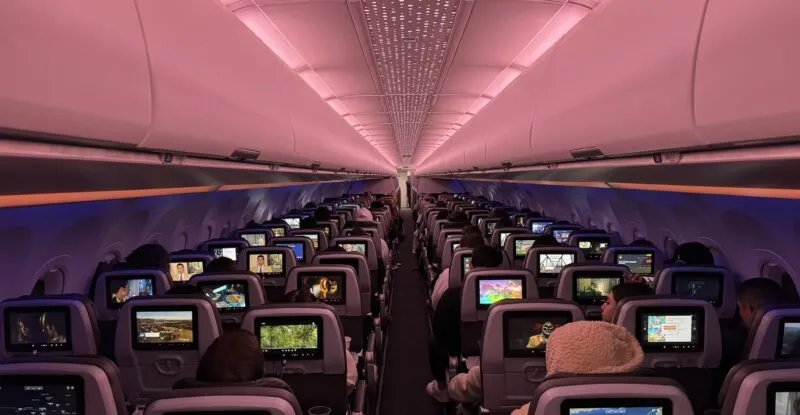
Using Quvia Sync, is it then possible for an aircraft to upload content or advertisements or stream to seatback IFC screens without interfering with the QoE of the passengers on their own devices?
“[T]hose are the types of things that we help airlines do, because if you are doing updates in the background and interfering with the QoE, that’s a problem. But if you have overage and it costs you two times what you needed to update, then you can’t afford it. So, it’s about managing all those pieces of the puzzle, and that’s what Quvia Sync does,” Moeller explains to RGN.

“Because the LEO networks are ushering in a generational change, therefore the backend now has an opportunity to be unique and to personalize the experience,” the Quvia executive continues.
“If everybody picks one LEO services provider, then everybody will have the same thing. Then airlines will all go compete in different places. But airlines want to differentiate, including with IFEC, and do it in an affordable way. They can do that, and effectively manage the cabin layer, with Quvia Grid and Quvia Sync. This gives them more flexibility and control.”
Whether airlines gravitate towards a single LEO provider, multi-orbit IFC configurations or indeed a multi-vendor environment on aircraft, Quvia Sync can seamlessly integrate the data sources on-premises to capture metadata and understand data context, while honoring data SLAs and cost constraints.
This ensures they can deploy and scale new applications, services and experiences at the edge to provide personalized, connected passenger experiences that continue across aircraft and flights.
Related Articles:
- Optimism abounds as Amazon eyes more open ecosystem for LEO
- Panasonic enjoys rapid IFE growth as connected seatback takes wing
- SES flags risk when airlines ‘hand over keys to Starlink’
- JetBlue partners with Quvia to advance IFC and ensure consistent PaxEx
- Qatar Airways to realize AI vision on 777X with Panasonic Converix
- Why Seamless is introducing Viper to measure IFC performance
- Viasat sees future opportunities to reengage with Starlink adopters
- Quvia sees aero following cruise with multiple connectivity providers
Featured image credited to Jason Rabinowitz