

U.S. Government shutdowns disrupt airport operations and a variety of private businesses, from airlines and bizjet operators to airport shops and restaurants. Please enjoy this Op-Ed contribution from Mohamed Yousuf, the CEO and founder of Smart Workforce AI.

When government shutdowns occur, they cause a significant amount of chaos and confusion for federally run programs and private entities. While discussions, deals, and decisions are being made behind closed doors, everyday people must adjust to the temporary “new normal.”
Inside our nation’s airports, shutdowns translate to airline schedules in upheaval, long lines, and unpredictable foot traffic for airport businesses including airport shops, restaurants, hotels, and premium lounges.
Business aircraft stakeholders are often also impacted. To wit, during the current partial U.S. Government shutdown, private jet flights have been prohibited at a dozen airports. The extra costs incurred could threaten some private companies.
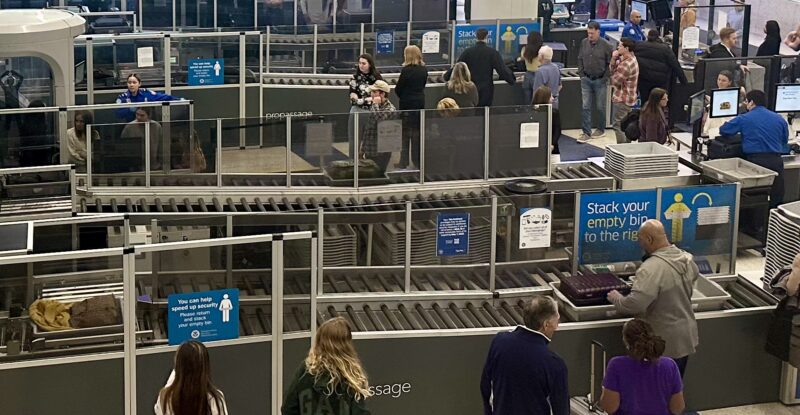
Even if the core functions of an airport are running — people slowly moving through TSA, planes taking off — the drastically reduced staffing and day-to-day uncertainty can erode the efficiency of the private sector, and cut into revenues.
Private-sector employees do not have the benefit of their jobs being protected, but they must work around the chokepoints that arise from the upheaval on the federal side.
An overall slowdown
At present, some TSA agents are admirably continuing to show up for work, though they are not receiving immediate paychecks (in what must feel like déjà vu, given that the last shutdown just ended on 12 November 2025.)
But when agents don’t show up or, understandably, quit, it creates a domino effect of long security lines, delayed departures, missed flights, frustrated travelers, and very few workable solutions.

Traveler behavior can also be impacted. In the face of three-plus-hour security wait times and backups, passengers may decide to either show up to the airport very early to wait, causing congestion, or cancel their trips altogether.
When travelers decide they would rather not battle the chaos at the airport, it hurts virtually all airport businesses.
Since the COVID pandemic, unruly passenger behavior has been on the rise. Will the stress and strain of traveling during this shutdown further exacerbate the problem?
These are all heavy considerations.
Bottom line
But the larger issue is this: repeated shutdowns normalize instability in airport operations and create vast uncertainty for the vast array of businesses that rely on airport space to operate.
Instability may lead some businesses to pump the brakes on innovation, idea generation, and growth.
That ultimately means higher costs for travelers and a less competitive airline industry overall, which is as much of a problem for the private sector as it is for the public.
 About the Author
Mohamed Yousuf is the CEO and founder of Smart Workforce AI, a workforce intelligence platform transforming how shift-based industries operate in an AI-driven world. Prior to Smart Workforce AI, Mohamed spent over a decade working in global aviation across airlines such as Air Canada and Etihad Airways. His background is rooted in leading crew planning, manpower strategy, and operational workforce optimization in highly complex, regulated environments. Today, through Smart Workforce AI, Mohamed focuses on helping organizations move away from rigid, approval-heavy scheduling models toward intelligent, adaptive systems that balance operational performance with greater employee autonomy.
Featured image credited to Mary Kirby