



Some partnerships are so synergistic that they simply make perfect sense from the outset. Such is the case with Swedish firm Flightradar24, which has expanded its flight tracking capabilities with the addition of Aireon’s space-based ADS-B data.
“Oceanic coverage and flight tracking over earth’s most remote areas is now fully possible thanks to the inclusion of Aireon’s space-based ADS-B data,” Flightradar24 says in an online blog post.
“The natural combination of Flightradar24’s world-leading terrestrial network with Aireon’s expansive satellite constellation ensures Flightradar24 users get the best, most accurate view of global air traffic at all times.”
A community-powered solution — and an AvGeek favorite — Flightradar24’s terrestrial ADS-B network includes more than 55,000 receivers across all seven continents, enabling it to track hundreds of thousands of flights every day. But “even the most extensive ground-based network has natural limitations — particularly over oceans, polar regions, and other remote areas,” the Swedish firm notes.
Enter Aireon. Based in McLean, Virginia, Aireon is a joint venture between L-band Low Earth Orbit (LEO) satellite operator Iridium and air navigation service providers (ANSPs) around the globe. Every satellite in Iridium’s 66-satellite NEXT LEO constellation carries Aireon’s payload, a space-based ADS-B receiver that monitors aircraft in real-time.
“When an aircraft is operating outside of Flightradar24’s terrestrial coverage or other satellite sources, position updates sourced from Aireon will be shown. Aireon positions will be displayed in 15-minute increments when the aircraft is outside terrestrial coverage areas,” Flightradar24 explains.
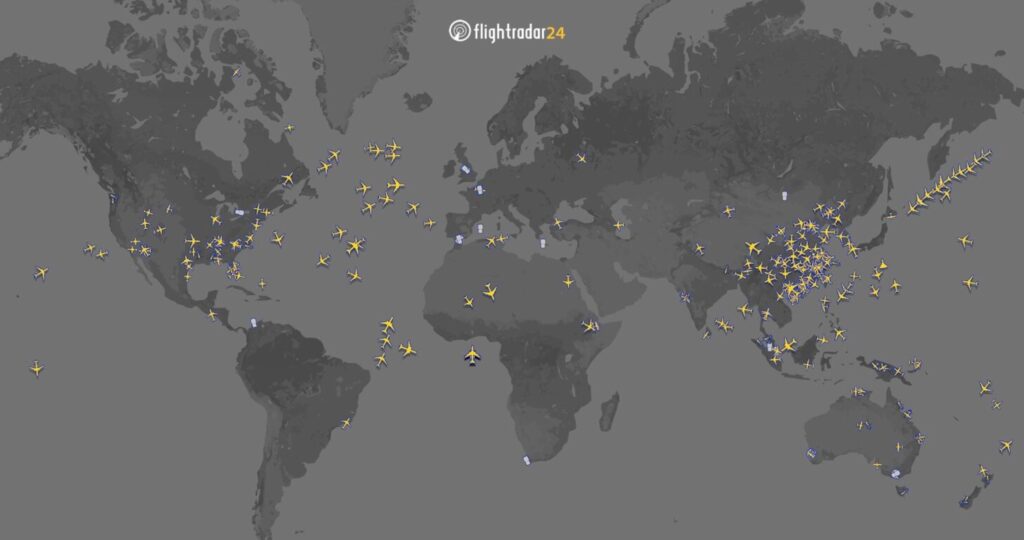
Look for the icons with blue outlines to see flights tracked via Aireon. Image: Flightradar24
Aireon VP of product management Chris Devlin tells RGN: “The partnership with FlightRadar24 is an excellent opportunity to showcase the power of Aireon’s commercial data across a wider range of stakeholders.”

Interestingly, the partnership is reciprocal in nature, as Aireon’s commercial customers now have access to Flightradar24 data.
“For Aireon, the fusion of the FlightRadar24 data unlocks positional information for commercial customers that is not captured in our space-based data feed. More specifically, that’s data from non-ADS-B equipped aircraft and/or aircraft transmitting in a different frequency,” says Devlin.
This Aireon-Flightradar24 pact comes at a time when the Aireon JV is on an impressive growth trajectory including with new and expanded partnerships.
Together with Iridium, Aireon is pursuing a space-based VHF initiative that is expected to ultimately relieve VHF congestion by enabling pilots to use existing VHF radios to communicate with ATC over L-band links via an Iridium follow-on network.
Related Articles:
- Iridium plans aviation disruption with Certus safety, space-based VHF
- Panasonic Avionics adds Flightradar24 live fleet data to Arc map
- Aireon sees opportunity to aid FAA in ATC modernization
Featured image credited to istock.com/yucelyilmaz. Embedded image credited to Flightradar24