


Having secured a raft of top-tier airlines as full-fleet customers, SpaceX’s Starlink Ku-band Low Earth Orbit (LEO) satellite-powered inflight connectivity has certainly made its mark in aviation over the past two years. Even so, there is still worthwhile business to be won including with carriers that are just starting to dip their toe into IFC and want flexible commercial models.
To that end, SES — which gained substantial scale through its acquisition of Intelsat, and currently provides IFC on over 3,000 commercial aircraft — has identified a target market of thousands of additional tails that would benefit from its partnership approach, one that sees the satellite operator and aero ISP draw on its decades of experience to provide “almost consultant-type services” including to small, mid-sized and low-cost carriers, SES vice president of global airline partnerships Enrique Villasenor tells Runway Girl Network.
SES can, for instance, help airlines build a business case for their connected aircraft programs. With teams positioned around the world, it can also provide the sort of regional, hands-on support that resonates with carriers that perhaps have never before adopted IFC.
Case in point: fast-growing Abra Group, the Latin American holding company for Avianca, GOL and Wamos Air, recently announced plans to bring SES’s Ku-band multi-orbit, ESA-based IFC solution to more than 100 aircraft in the group, including Airbus and Boeing types. Avianca is an IFC newbie, and at least ten A320s in its fleet are already flying with the service, as powered by SES’s geostationary (GEO) satellites and Eutelsat OneWeb’s LEO service, for which SES is a distribution partner in aero.
This Latin American win is especially meaningful as SES already counts Abra Group’s main rival LATAM — notably an early proponent of the free Wi-Fi model — as a customer for its 2Ku solution across the carrier’s narrowbody fleet (Viasat recently won the widebody business). Abra Group member GOL is also an existing 2Ku customer. And whilst Viasat won Aeromexico’s 737 MAX and E190 IFC business, 2Ku is still flying on some Aeromexico 737-800s.
In short, SES has mopped up a fair amount of IFC business in the region.
“Latin America has been a shining spot for us, not just in terms of aircraft, but operationally, like it’s a really good service, and people like it,” Villasenor enthused of 2Ku. This in turn aided SES in its negotiations with Avianca and parent Abra as the airline had studied its competitor’s Wi-Fi service, and SES was able to offer what it bills as “the next generation” in the form of its multi-orbit ESA terminal.
“And we say, ‘look, we’ll hold your hand and we’ll show you how we do it. We’ve done it for years.’”
This flexibility is among the reasons why aviation continues to be a “growth engine” for SES, as company CEO Adel Al-Saleh highlighted during the firm’s third quarter 2025 earnings conference call.
Said Al-Saleh:
While competition from LEO-only providers remains very strong, the market is large and diverse enough to support multi-players offering solutions tailored to the specific needs of airlines.
EPFD, resiliency and geopolitical considerations
Interestingly, physics also played into SES’s recent Avianca win. We’re told that Starlink service degrades when aircraft fly near or across the equator, as terminals must adhere to EPFD requirements and restrictions to avoid interference with Clark Belt GEO satellites. Some satellite industry executives claim passengers can expect meaningful degradation for roughly 1,200 miles, as capacity around the equator, ‘if you’re flying either east/west or north/south, is massively degraded’.
Did these types of considerations enter the conversation with Bogotá-based Avianca, when it was mulling SES’s multi-orbit LEO/GEO solution, RGN asked? “It certainly did. I mean, it’s physics, right? I think it’s not one of these rumors. It’s like, it’s physics,” said Villasenor. “You’d be amazed Mary, I would say nine out of 10 RFPs that I’m seeing now explicitly require multi-orbit. I think redundancy matters,” he continued.
Airlines have also seen this whole industry go through now a couple of technology cycles — if you go back to ATG, and then Ku or Ka gimbaled antennas, I think they now know what to ask. And they’re saying, ‘look, I need redundancy. I think it’s great. LEO is awesome, but it is just the latest flavor. Like, you got to provide me with some certainty.’ And I think that’s where our story really is resonating on the marketplace, and what I’m seeing in the RFPs.
If there is a blackout (or in-orbit break-up), whether in LEO or GEO, multi-orbit IFC also provides crucial backup. “On the GEO front, when we lost IS-33 as Intelsat, we were up and running within a week because our approach is pretty agnostic. If we don’t have an asset in a certain part of the world, or if it makes more sense to buy capacity off some other Ku operator, we will do that,” Villasenor said. “That’s a big part of what we’re talking to airlines about.”
There is also “obviously the geopolitical kind of issues that you have with LEO that you don’t have with GEO” including for airlines that fly into and over China and Russia (of note: China Southern recently picked SES as MSP for 30 A350s contracted with Airbus’ linefit, supplier-furnished HBCplus Ka-band IFC program).
Open Orbits advances
Meanwhile, SES is also advancing a plan to bolster its ‘Open Orbits’ Ka-band, multi-orbit MEO/GEO offering, including with a next-generation solution that will add multi-network, multi-beam, and multi-band (Ka/Ku) functionality.
One way to do that would be to pair the ThinKom Solutions Ka2517 VICTS antenna that already supports Open Orbits with a Ku-band LEO-only ESA that talks to Eutelsat OneWeb LEO, as SES senior product executive Blane Boynton previously explained to RGN.

SES is both “talking internally” about that kind of solution as a retrofit option and speaking with Airbus about it, as the European airframer is presently honing its linefit supplier-furnished HBCplus program to accommodate the new NGSO constellations and the rapidly evolving IFC landscape, Boynton said. And, given its acquisition of Ku-band HBCplus MSP Intelsat, SES is now a managed service provider in both the Ka- and Ku-band sides of the Airbus program.
ThinKom Solutions CTO Bill Milroy noted that Ka2517, even without an accompanying ESA, works “very nicely” on GEOs, MEOs (SES mPOWER), HEOs (Viasat GX 10A/B), and LEOs (the Telesat Lightspeed network and possibly another forthcoming Ka-band LEO network.)
“For some, that will be more than enough,” he told RGN. For others, the addition or pairing of a Seamless Air Alliance Type 2 LEO-only ESA “further opens up the Ku (and Ka) multi-beam options.”
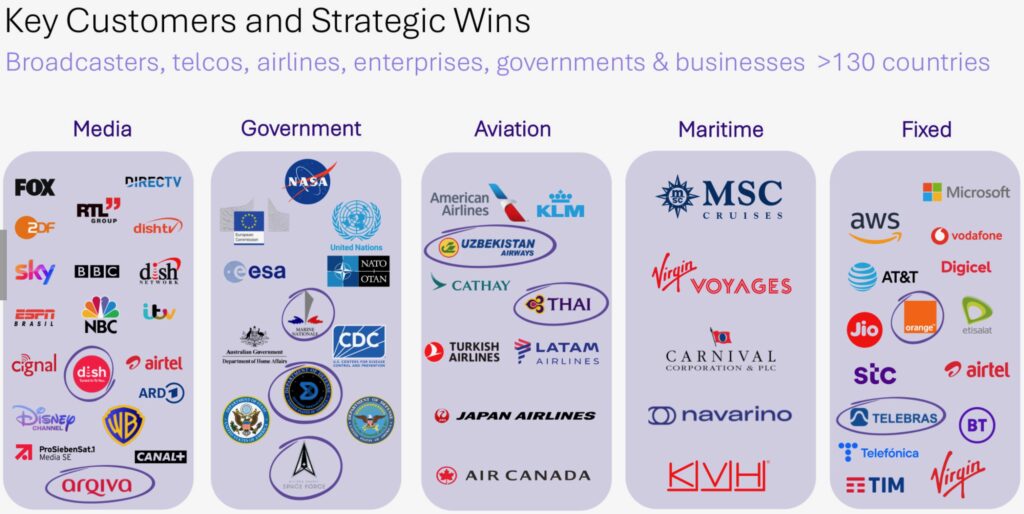
SES has made strategic wins in aviation and other verticals, securing key business for its multi-orbit IFC business with American Airlines, Air Canada Japan Airlines and Abra Group, and Open Orbits business with THAI, Turkish Airlines and Uzbekistan Airways.
Related Articles:
- Avianca rolls out SES multi-orbit IFC on A320 Family twinjets
- How United is leveraging Starlink and the cloud to enhance IFE
- EPFD limits in the spotlight as ITU selects Shanghai for WRC-27
- Hughes positions newly acquired Anderson as hub for rapid prototyping
- IAG taps Starlink to power inflight Wi-Fi for 500-plus aircraft
- China Southern picks SES as MSP for 30 A350s contracted for HBCplus
- SES looks to bolster Open Orbits for airlines
- How Boeing Global Services is supporting Starlink installs on 787s
- Air Canada extols virtues of SES multi-orbit IFC, nears E175 installs
Featured image credited to SES