
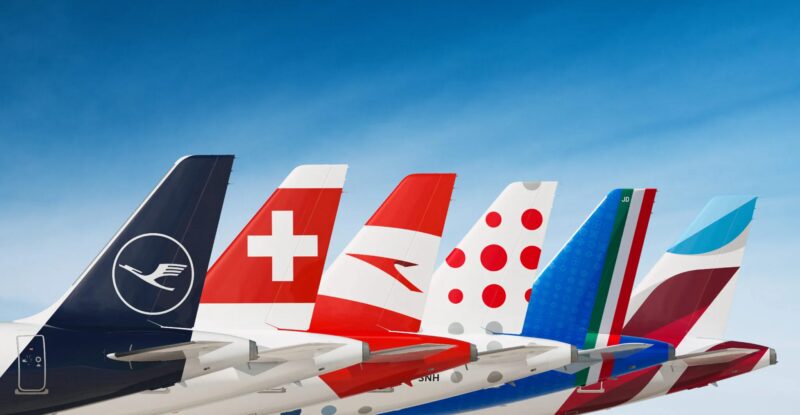

In a surprise announcement, Lufthansa Group has selected SpaceX’s Starlink Ku-band Low Earth Orbit (LEO) satellite-supported inflight connectivity for its entire fleet, and will offer the service free of charge to all status customers and Travel ID users across all travel classes.
Some 850 aircraft have been earmarked to be fitted with the high-speed broadband service, both within Lufthansa Group’s existing fleet and “on all new aircraft,” it says. That means that even smaller operators within the Lufthansa Group, including Air Dolomiti, Edelweiss Air, and Discover Airlines are in line for equipage.
The “gradual introduction” of Starlink is expected to begin in the second half of 2026 and extend to 2029.
The news is a blow to Lufthansa Group’s stalwart IFC providers including Panasonic Avionics and Viasat-previously-Inmarsat, which have long provided geostationary (GEO) satellite-based service on its widebodies and narrowbodies, respectively. And it begs questions about the status of Panasonic’s multi-orbit LEO/GEO IFC program for Discover Airlines’ A330s.
But it’s also a big hit to the Viasat/Deutsche Telekom-run European Aviation Network (EAN), the hybrid air-to-ground/S-band offering that is in the process of being installed on single-aisle aircraft flown by Lufthansa Group carriers Austrian Airlines, Lufthansa, and SWISS. Indeed, Lufthansa Group’s Starlink announcement has dropped just two short months after it said it was “on track” to complete EAN installs by the end of 2026.
So, what changed since November?
In that short timeframe, industry heavy hitters including Emirates, Korean Air and its Hanjin Group sisters became the latest confirmed full-fleet customers for Starlink, adding to a raft of others including Lufthansa Group rivals and partners: IAG Group, which like Lufthansa Group is ditching EAN for Starlink, plus Air France, Qatar Airways, SAS, Virgin Atlantic and fellow Star Alliance member United Airlines, which is leveraging Starlink and the cloud to enhance inflight entertainment.
Other Starlink customers include Alaska Airlines, airBaltic, WestJet, ZIPAIR and US hop-on jet operator JSX. Air New Zealand’s trial of the service includes a fitted ATR-72 turboprop, whilst Air Canada is bringing Starlink to its Q400s.
Additionally, and notably, there are open questions about the future use of the 2 GHz MSS frequency band that is presently used by Viasat to provide EAN services in Europe.
Yesterday, the UK set the wheels in motion to revoke a 2010 regulation that authorized the frequency use, saying that the revocation will take effect from 14 May 2027, “ensuring continuity for current license holders until expiry” on 13 May 2027.
Final decisions will be made by the UK’s communications regulator, Ofcom, which “intends to consult on future options for the band, and operators will be invited to provide views before any decisions are made.”
During the UK’s consultation period, Viasat opposed revocation.
The European Commission, meanwhile, has received feedback from its own targeted consultation on the matter, and is mulling next steps.

Explaining Lufthansa Group’s decision to select Starlink, company chief commercial officer Dieter Vranckx says in a statement: “In our anniversary year, in which we are celebrating Lufthansa’s 100th birthday, we have decided to introduce a new high-speed internet solution from Starlink for all our airlines.
“The Lufthansa Group is taking the next step and setting an essential milestone for the premium travel experience of our customers. Connectivity on board plays an important role today, and with Starlink, we are not only investing in the best product on the market, but also in the satisfaction of our passengers.”
Starlink is expected to enable “streaming, cloud-based working, and other high-speed applications” and is part of Lufthansa Group’s broader investment in new aircraft and premium products.
Related Articles:
- How United is leveraging Starlink and the cloud to enhance IFE
- Qatar Airways becomes first in the world to bring Starlink to 787s
- SES targets thousands of additional tails for IFC partnership model
- Lufthansa receives Allegris-fitted 787 with most biz seats blocked
- Emirates confirms fleet-wide deal for Starlink-powered free Wi-Fi
- Lufthansa Group presses ahead with EAN inflight connectivity installs