
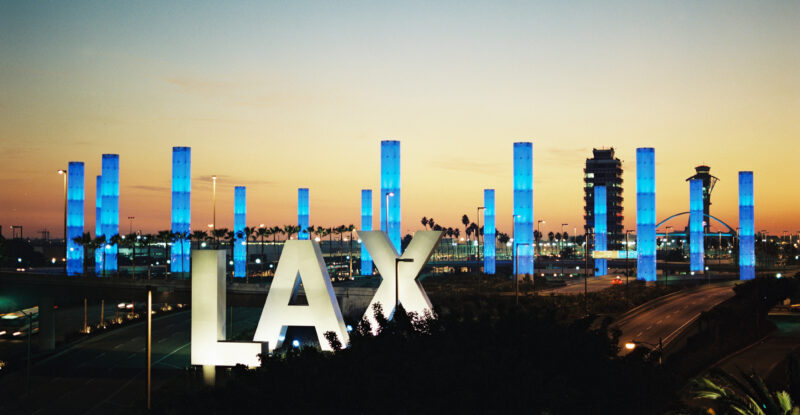
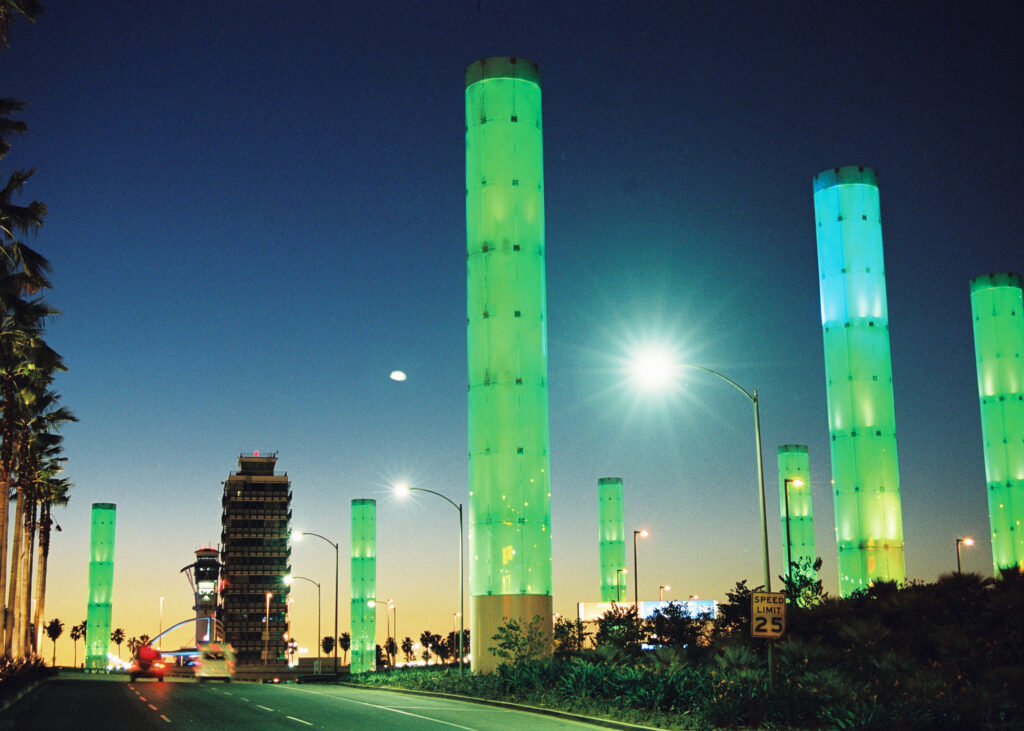
 This week, Los Angeles World Airports (LAWA) began removing the iconic ring of 15 pylons that have illuminated the entrance to Los Angeles International Airport (LAX) for the past 25 years.
The removal of these pylons is part of LAX’s Airfieldand Terminal Modernization Program (ATMP) Roadway Improvements Project, which will ease traffic congestion and improve traffic flow into, out of and around the airport.
“Since their installation in 2000, the iconic LAX pylons have stood as a vibrant symbol of LAX and Los Angeles, welcoming more than 1.2 billion visitors from around the world,” said Michael Christensen, Chief Airport Development Officer, Los Angeles World Airports.
“As part of the roadway modernization project, we have a unique opportunity to reimagine their design during this exciting new chapter in LAX’s transformation as our teams diligently prepare for the construction of elevated roadways that will ease congestion, enhance safety, and deliver a world-class experience for travelers and our community.”
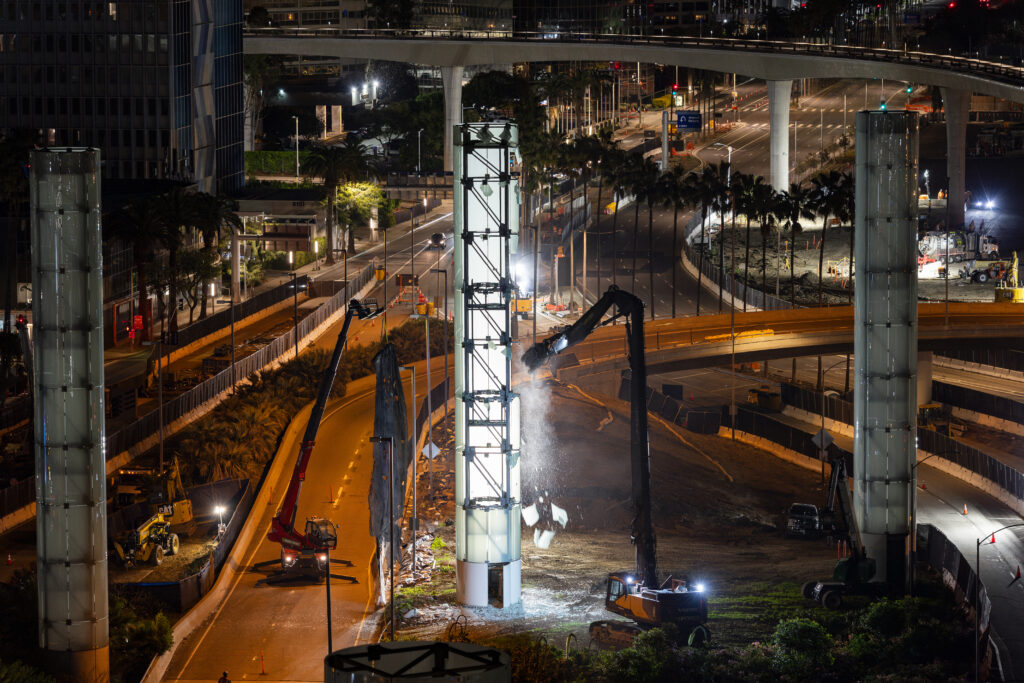
While the removal of the pylons marks a significant milestone, LAWA is committed to preserving their legacy. Pylon artist Paul Tzanetopoulos is currently working with the ATMP project team to develop a new design and configuration of the pylons that will capture the spirit of innovation that defines LAX. New, reimagined pylons will be installed upon completion of roadway improvements.
The ring of 15 pylons is part of a total of 26 illuminated pylons that spanned 1.5 miles along Century Boulevard, each ranging from 25 to 100 feet in height. Pylon removal activity began along Century Boulevard earlier this month, though others were previously removed to make way for LAX’s forthcoming Automated People Mover train.
The ATMP Roadway Project, the most significant roadway upgrade at LAX in nearly four decades, will reconfigure 4.4 miles of roads to separate airport-bound from neighborhood traffic, reduce congestion, and improve vehicle and pedestrian access to LAX’s Central Terminal Area (CTA) and surrounding neighborhoods.
Elevated ingress and egress roadway systems will provide streamlined routes and enhanced safety for vehicle traffic local to LAX. LAWA anticipates completion of ingress roadways ahead of the 2028 Summer Olympics, with full completion of egress roadways expected by 2030.
The ATMP Roadways project compliments new mobility options that will be available upon the opening of SkyLink, LAX’s automated people mover, which will connect the airport to Los Angeles’ regional transportation network. Both projects are part of LAWA’s $30 billion capital improvement program and reflect substantial investments in improving the guest experience, community connectivity, and airfield safety.
Please visit the ATMP Roadways project page for more information.

About Los Angeles International Airport (LAX)
LAX is owned and operated by Los Angeles World Airports (LAWA), a proprietary, revenue-generating department of the City of Los Angeles that also governs Van Nuys Airport (VNY). As the international gateway to the Southern California region, LAX and its partners are dedicated to meeting global airport standards for customer satisfaction, safety, regional economic leadership, organizational performance and sustainability.
To better serve the millions of domestic and international guests that travel through LAX each year, the airport is undergoing a multi-billion-dollar capital improvement program to modernize its entire campus.
As a covered entity under Title II of the Americans with Disabilities Act, the City of Los Angeles does not discriminate on the basis of disability and, upon request, will provide reasonable accommodation to ensure equal access to its programs, services, and activities. Alternative formats in large print, braille, audio, and other forms (if possible) will be provided upon request.
All images credited to Los Angeles World Airports